In June 2026, Alphabet did something the company never needed to do for two decades: ask its shareholders for money. $84.75 billion of fresh capital for data centers and chips — the largest equity raise in the company's history, with Warren Buffett's Berkshire Hathaway as anchor investor. A money-printing machine borrowing money to build an even bigger machine. This is exactly the point where it gets decided what Alphabet is for owners today.
"For twenty years this company handed money back to its shareholders. Now it reverses the flow. Whoever buys the stock isn't buying a search engine — they're financing an arms race."
1) Quick Overview
| Metric | Value |
|---|---|
| Ticker | GOOGL (NASDAQ, Class A) |
| Price (August 2026) | $340.67 |
| Market Capitalization | $4.17 trillion |
| P/E Ratio (trailing) | 17.1× — distorted, see section 6 |
| EPS (TTM) | $19.93 — incl. one-off valuation gains |
| P/B Ratio | 6.5 |
| Dividend Yield | 0.26% ($0.88/year, first dividend 2024) |
| Net Cash (June 30, 2026) | ~$122B |
| Sector | Communication Services / Internet |
Alphabet is the holding company behind Google: the world's dominant search engine, YouTube, Android, Chrome, Gmail and Maps — plus Google Cloud as the third-largest cloud provider and Waymo as the leading robotaxi operator. Roughly 90% of all search queries worldwide run through Google (StatCounter). The company earns its money almost entirely by converting attention into advertising revenue.
2) Business Model & Segments
The business model is a loop, not a list. Billions of people use free products and pay with attention and data. That reach is sold to advertisers. The profit flows into AI infrastructure that makes the products better — and builds new pillars along the way.
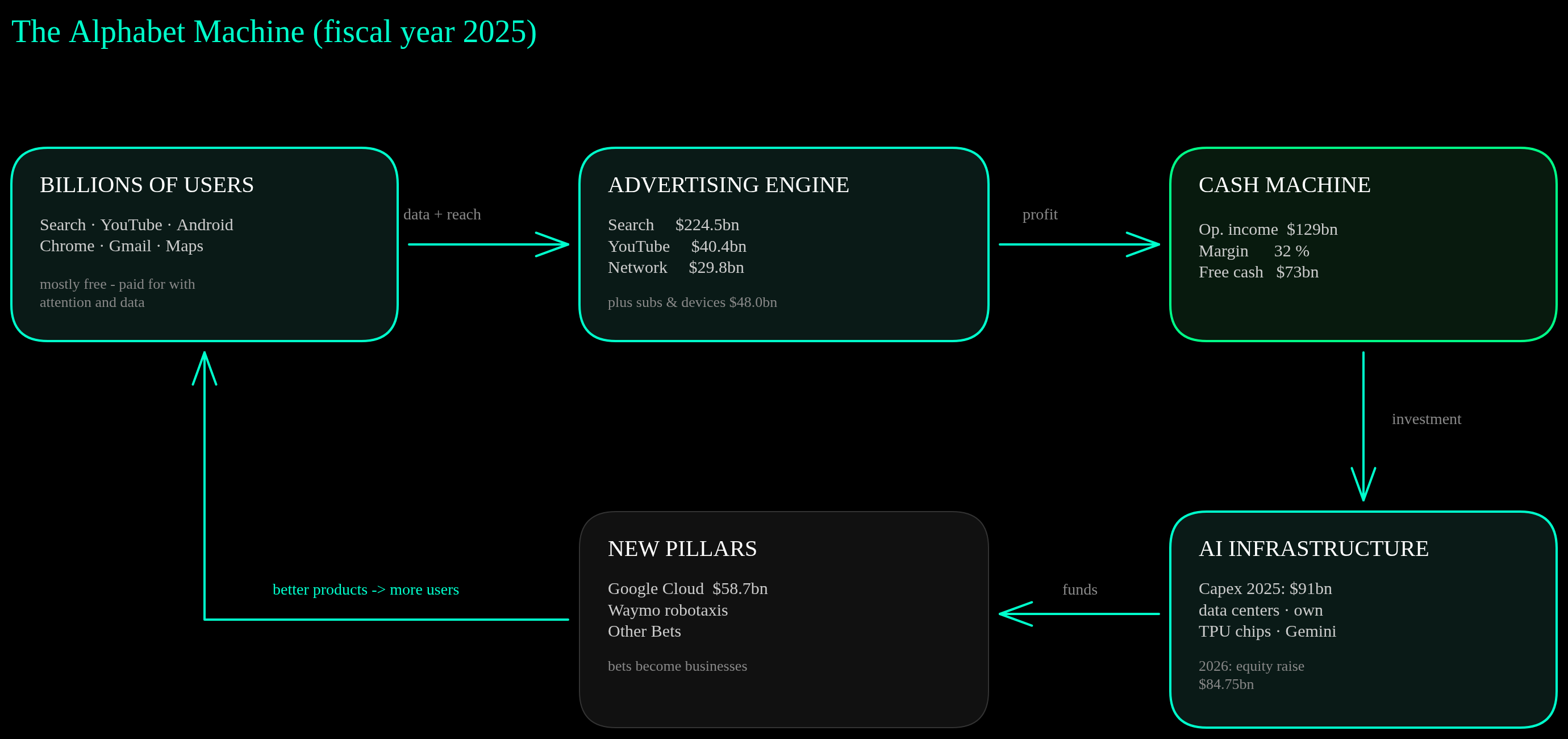
The Alphabet machine as a loop: free products generate reach, advertising generates cash, cash generates infrastructure — which carries the new pillars. ↗ Click to zoom
The numbers behind it, from fiscal year 2025 (total revenue $402.8B, +15%):
- Google Services — $342.7B (85% of revenue): search advertising $224.5B, YouTube advertising $40.4B, ad network $29.8B, plus subscriptions, platforms and devices (YouTube Premium, Google One, Pixel, Play Store) at $48.0B.
- Google Cloud — $58.7B: infrastructure, AI platform and Workspace. The fastest-growing segment — and since the AI wave, the second growth engine.
- Other Bets — $1.5B: Waymo (robotaxis), Verily and other long-term bets. Tiny in revenue terms, strategically a collection of options.
The moat: not a single moat, but a system of self-reinforcing advantages. Network effects (more users → better data → better results → more users), switching costs inside the ecosystem (Android, Chrome, Gmail, Photos), economies of scale in data centers and in-house TPU chips — and a distribution power competitors would first have to replicate. Exactly this interlocking was the subject of two antitrust cases, more on that below.
3) Growth & Development
| Year | Revenue | EPS | Op. Margin |
|---|---|---|---|
| 2021 | $257.6B | $5.61 | 30.6% |
| 2022 | $282.8B | $4.56 | 26.5% |
| 2023 | $307.4B | $5.80 | 27.4% |
| 2024 | $350.0B | $8.04 | 32.1% |
| 2025 | $402.8B | $10.81 | 32.0% |
The pattern is the opposite of a cyclical: revenue grew in every single year, even through the 2022 rate shock, when earnings briefly dipped. Since 2023 growth has been accelerating again — +15% in 2025, and the first two quarters of 2026 stepped it up once more: Q1 +22%, Q2 +24% year over year. A company with over $400 billion in revenue growing the way it did ten years ago, when it was a quarter of its current size.
The real driver sits in the cloud: +82% in the second quarter of 2026, an order backlog of over $460 billion and a segment margin of around 36% by now. What was once a subsidized side business has become the second earnings pillar.
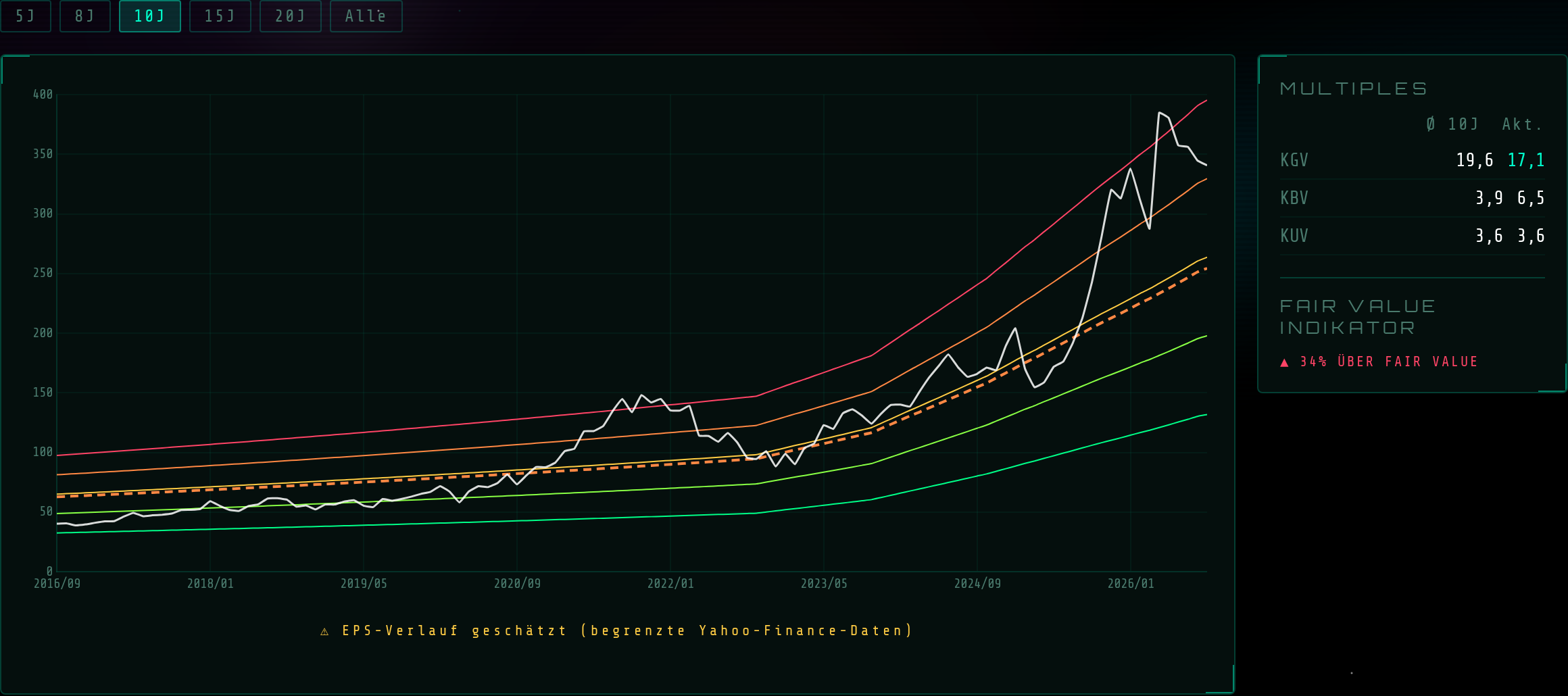
Alien Analyzer V2 — Fair Value tab: The price ran away above its historical valuation bands in 2025/2026 — the indicator flags 34% above fair value. Why the P/E still looks "cheap" is resolved in section 6. ↗ Click to zoom
4) Profitability & Balance Sheet
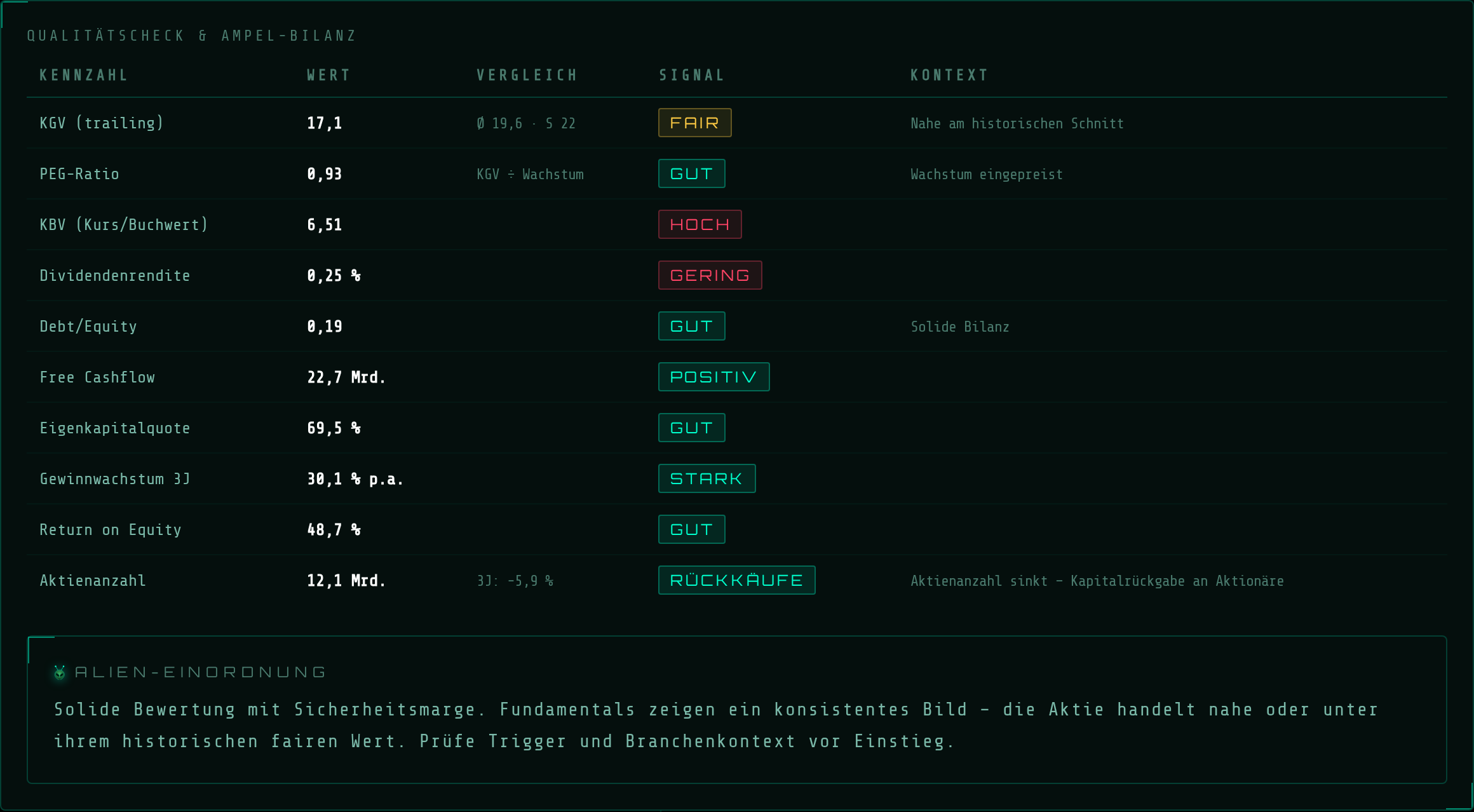
Alien Analyzer V2 — Quality Check: Traffic light overview of key metrics with contextual assessment. ↗ Click to zoom
At first glance, a picture-book balance sheet: equity ratio 69.5%, debt/equity 0.19, net cash of around $122 billion even after deducting all debt — plus an ROE of almost 49%. By our strict definition this is no longer a tank balance sheet (total debt quadrupled to ~$121B in 2025/2026), but it is still one of the most solid balance sheets among the megacaps.
But looking under the hood belongs in every honest analysis: fiscal 2025 delivered $164.7B of operating cash flow and, after $91.4B of capex, still $73.3B of free cash flow. In 2026 that picture flips. Investments have exploded to $132.4B over the last twelve months, capex guidance for 2026 stands at $175–185B — and in the second quarter of 2026 free cash flow was negative for the first time (−$5.9B). At the same time, share buybacks paused completely in the first half of 2026. The machine still earns magnificently, but right now it is keeping its money for itself.
On the dividend: Alphabet has only been paying since 2024 — starting at $0.20 per quarter, raised to $0.22 in July 2026 ($0.88/year, 0.26% yield). More symbolic than substantial, but a signal: the pure growth stock is slowly turning into a distributor. The path Microsoft and Apple mapped out.
5) Strategic Themes
The capital raise — $84.75B (June 2026): four building blocks. $18B of new common stock (Class A placed at $355.20), $16.75B of mandatory convertible notes with a 6.25% coupon and forced conversion in May 2029, an at-the-market program of up to $40B (per the prospectus primarily for tax obligations from employee stock compensation) — and a $10B private placement with Berkshire Hathaway. Against the dilution from the conversion, Alphabet hedged with capped calls up to ~50% above the issue price. What's remarkable is less the mechanics than the message: even $73B of free cash flow per year is no longer enough for this arms race.
Antitrust, part 1 — search: In September 2025, Judge Mehta decided the remedies in the search monopoly case: no forced sale of Chrome or Android, but a ban on exclusive distribution agreements (Search, Chrome, Assistant, Gemini) and an obligation to share certain search data with qualified competitors. The billions in payments to Apple remain allowed as long as they are not exclusive. The remedies have been in force since February 2026 — both sides have appealed.
Antitrust, part 2 — ad tech: In April 2025, Judge Brinkema found illegal monopolies in publisher ad servers and ad exchanges. The remedies decision — up to and including a possible forced sale of parts of the ad-tech business — is still pending as of August 2026. During the hearing, the judge showed herself skeptical of a breakup. This remains the biggest open legal item.
AI offensive: The Gemini app officially crossed one billion monthly active users in August 2026. The $32B acquisition of cloud security provider Wiz closed in March 2026. In August 2026, Waymo opened its cheaper robotaxi generation in San Francisco, Los Angeles and Phoenix to all riders — with a self-developed AI chip (over 1,000 TOPS) that reduces the dependence on Nvidia. The shadow over it: the departure of chief scientist Jeff Dean after 27 years (August 2026) shows how hard the fight for AI talent has become, even for Alphabet.
Outlook (analyst consensus, stockanalysis.com): Revenue 2026E: $497.7B (+24%) | EPS 2026E: $20.58 | EPS 2027E: $14.77. The optical EPS decline in 2027 is not a profit warning but normalization: 2026 is inflated by one-off valuation gains on investments — more on that in a moment.
6) Valuation in Context
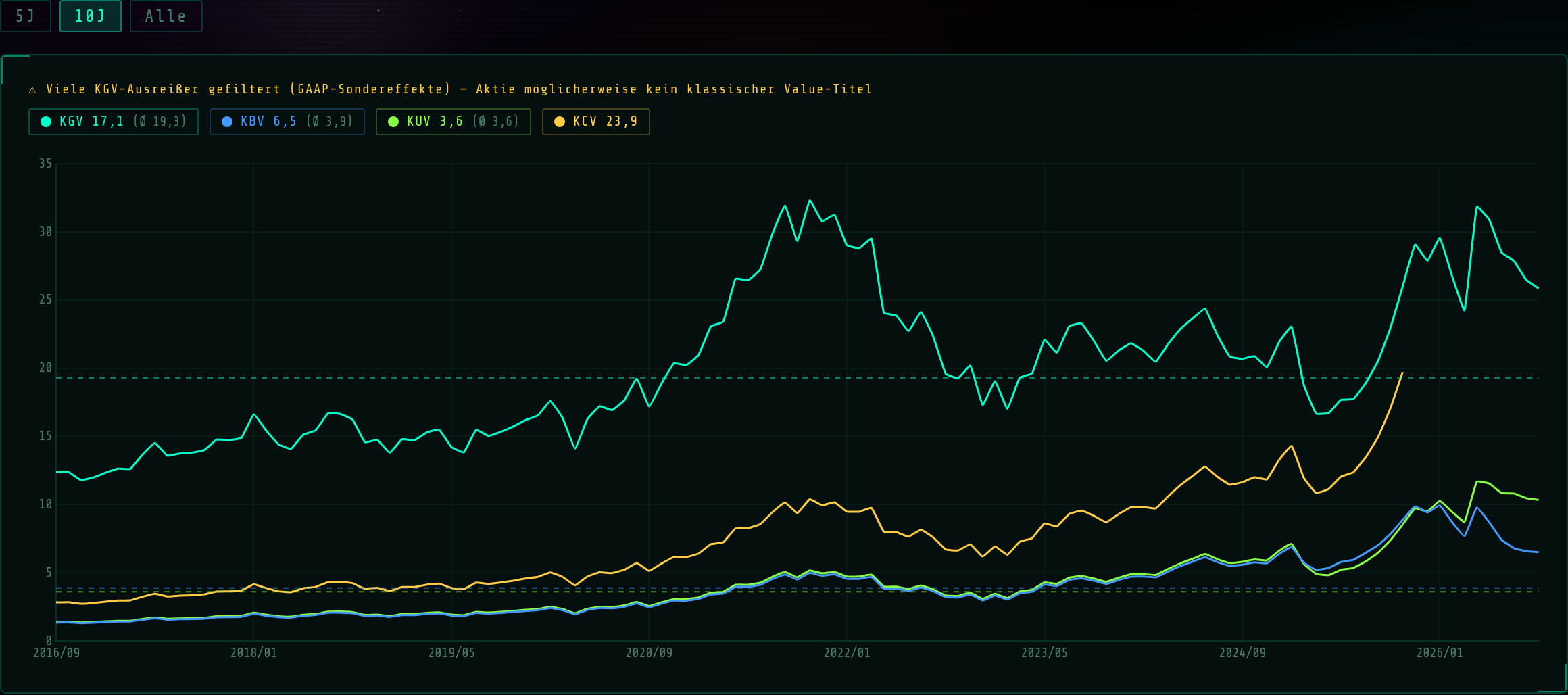
Alien Analyzer V2 — Multiples tab: P/E 17.1 below the 10-year average of 19.6 — and the warning "many P/E outliers filtered, possibly not a classic value stock". Note: the displayed P/S (3.6) is a data error in the Yahoo source, the correct figure is ~9.3. ↗ Click to zoom
* P/S corrected against stockanalysis.com (9.3) — the Analyzer's Yahoo data base incorrectly shows 3.6 here.
Here sits the most important lesson of this analysis. The trailing P/E of 17 looks like a gift — a world-class company below its own ten-year average. But it is an optical illusion, just in the opposite direction from a cyclical: in the first half of 2026, Alphabet booked around $136B of valuation gains on investments (+$6.26 per share in the second quarter alone). Those gains are genuinely on the books, but not repeatable — they inflate the E in the P/E.
Run the numbers with the normalized analyst consensus for 2027 ($14.77 EPS) and the P/E stands at about 23 — above the historical average, not below it. The Analyzer's fair value indicator (34% above fair value) tells the same story as the P/B of 6.5 against an average of 3.9: the market is paying a hefty quality and AI premium here. That can be justified if Cloud and Gemini deliver. But this stock is no bargain in August 2026 — no matter what the trailing P/E whispers.
Tool Tip
The metrics in this analysis come from Alien Analyzer V2 — the in-house screening tool for stocks. Fair value, multiples, dividends and quality check at a glance. Free, no login, no subscription.
alien-investor.org/alien-analyzer — Enter a ticker and analyze.
7) Competitive Landscape & Moat
| Company | Battlefield | Position (mid-2026) |
|---|---|---|
| Alphabet (GOOGL) | Search, advertising, cloud, AI, robotaxi | Search ~90%, Cloud 15%, Gemini 1B MAU |
| OpenAI (private) | AI assistants / the new kind of search | ChatGPT ~900M weekly users |
| Microsoft (MSFT) | Cloud, AI, search (Bing) | Azure 20% cloud market share |
| Amazon (AMZN) | Cloud, advertising | AWS 28% — market leader, but share declining |
| Meta (META) | Digital advertising, AI | World's second-largest ad platform |
| Tesla (TSLA) | Autonomous driving | Robotaxi ambitions, Waymo drives ahead |
The real front line doesn't run through Bing. Microsoft's search engine hasn't taken ten percentage points from Google in fifteen years. The real threat is the change in behavior: anyone who wants an answer increasingly asks an AI assistant instead of ten blue links. ChatGPT already reaches around 900 million weekly users. Alphabet counters with Gemini (1 billion monthly users) and AI answers directly in search — defending its monopoly by cannibalizing its own business model before others do. So far, the feat is succeeding: search revenue keeps growing at double-digit rates.
In the cloud, the balance of power is shifting: AWS leads with 28% but is losing share — Google Cloud reached a record 15% share with +82% growth in Q2 2026 (Synergy Research). The in-house TPU chip family is a structural advantage here: Alphabet is the only hyperscaler that builds AI models, chips and data centers entirely from a single source.
8) Customer Perspective
Alphabet's paying customers are not the billions of users — they are advertisers and cloud customers. For advertisers, Google Search is simply the place where purchase intent arises: there is no second platform with comparable reach among people actively searching. That lack of alternatives is the core of the pricing power — and exactly the point the antitrust courts classified as monopoly abuse.
In the cloud business, the order backlog of over $460B and large-customer deals speak for themselves. Public B2B satisfaction scores in the classic sense don't exist for either customer group. [NOT AVAILABLE]
9) Employee Perspective
Alphabet has been one of the most sought-after employers in tech for two decades — high compensation, generous stock packages (by now so large that part of the ATM program finances their tax bill). But the AI era has brought a new dynamic: top researchers are the most fought-over asset in the industry, and even Alphabet loses prominent minds to startups — most recently chief scientist Jeff Dean after 27 years. Systematic employer review data is not evaluable for this analysis. [NOT AVAILABLE]
10) Opportunities & Risks
11) Alien Verdict
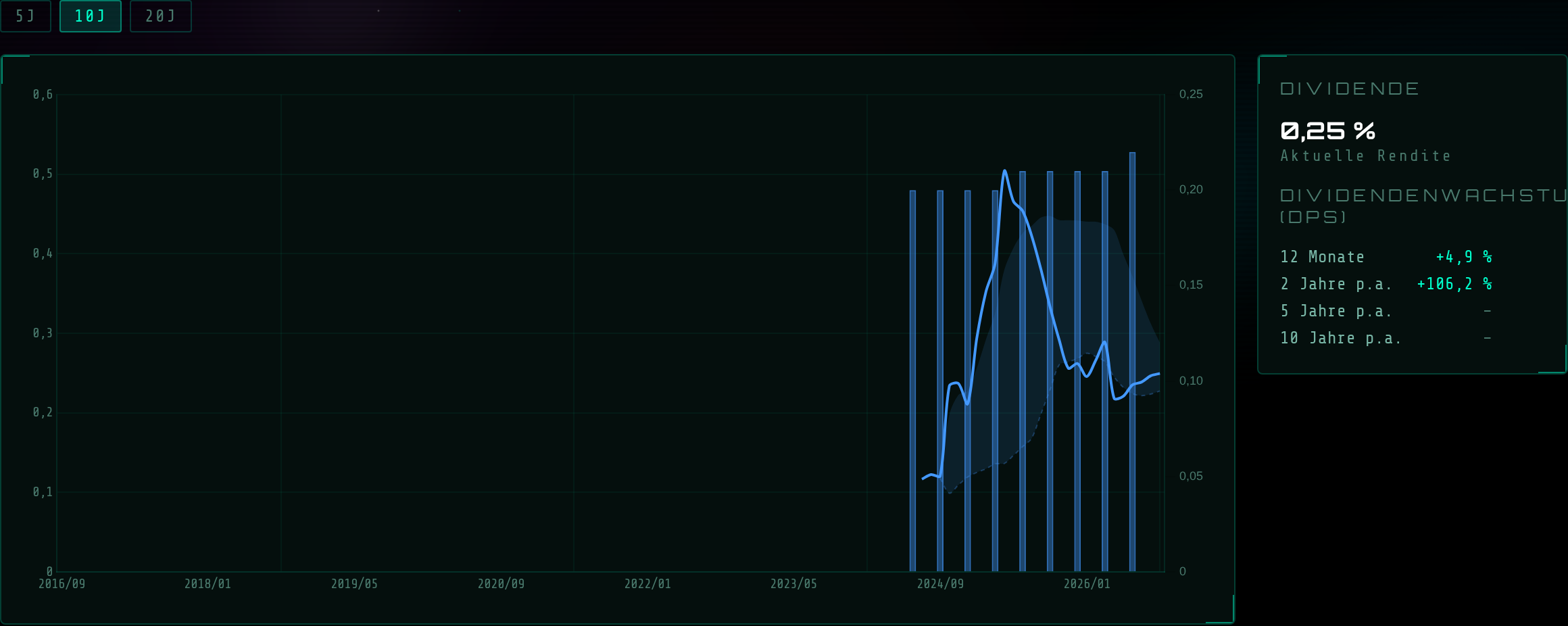
Alien Analyzer V2 — Dividends tab: The history only begins in 2024 — the pure growth stock is just turning into a young dividend payer. ↗ Click to zoom
Alphabet is one of the best business models ever built: a self-reinforcing loop of reach, data and cash, protected by network effects and an infrastructure nobody else can afford to duplicate. The core business is growing at over 20%, the cloud is exploding, and with its first dividend in 2024 the company has taken the path Microsoft and Apple demonstrated — from growth stock to distributor.
But the stock of August 2026 is a different bet than it was two years ago. The company is investing $175–185B in a single year, quarterly free cash flow has turned negative for the first time, buybacks are paused, and for the first time since its early years Alphabet is raising fresh equity at scale — $84.75 billion. That Buffett takes $10 billion of it is a remarkable seal of approval. It doesn't change the fact that cash flow present is being traded for AI future here.
And the valuation already prices in success: the optically cheap P/E of 17 is distorted by one-off gains — normalized, the stock trades at about 23 times earnings and 6.5 times book value, well above its own historical averages. Whoever buys here buys quality at a quality premium and bets that the largest investment program in the company's history will pay off. For owners with a long horizon, that is a legitimate bet on perhaps the most resilient ecosystem in the world. A bargain it is not.
"Owning the best machine in the world is only half the art. The other half is what you pay for it — and right now you're also paying for the arms race."