By its own account, Schindler moves over two billion people every day — and hardly anyone thinks about the company while riding. That is precisely the business model: invisible infrastructure that must be serviced by law, runs for 20 to 30 years, and then gets modernized. In 2025, the Swiss group completed its four-year recovery plan with a record margin. The question is not whether the business is good — it is what you pay for it.
"An elevator is sold once — and then maintained for three decades. Schindler does not sell cabins. Schindler sells a subscription to gravity."
1) Quick Overview
| Metric | Value |
|---|---|
| Ticker | SCHP / SCHN (SIX Swiss Exchange) |
| Price SCHP (August 2026) | CHF 265.60 |
| Market cap | ~CHF 28 bn |
| P/E ratio (trailing) | 27.6× |
| EPS (TTM) | CHF 9.61 |
| P/B ratio | ~5.5–6 |
| Dividend (FY 2025) | CHF 6.80 — yield 2.6% |
| Sector | Industrials / Elevators & Escalators |
Schindler is one of the world's largest manufacturers of elevators, escalators and moving walks — founded in Central Switzerland in 1874, with its operational headquarters in Ebikon near Lucerne and the holding company domiciled in Hergiswil. Before talking about the business, you need to understand a Swiss peculiarity: there are two listed securities.
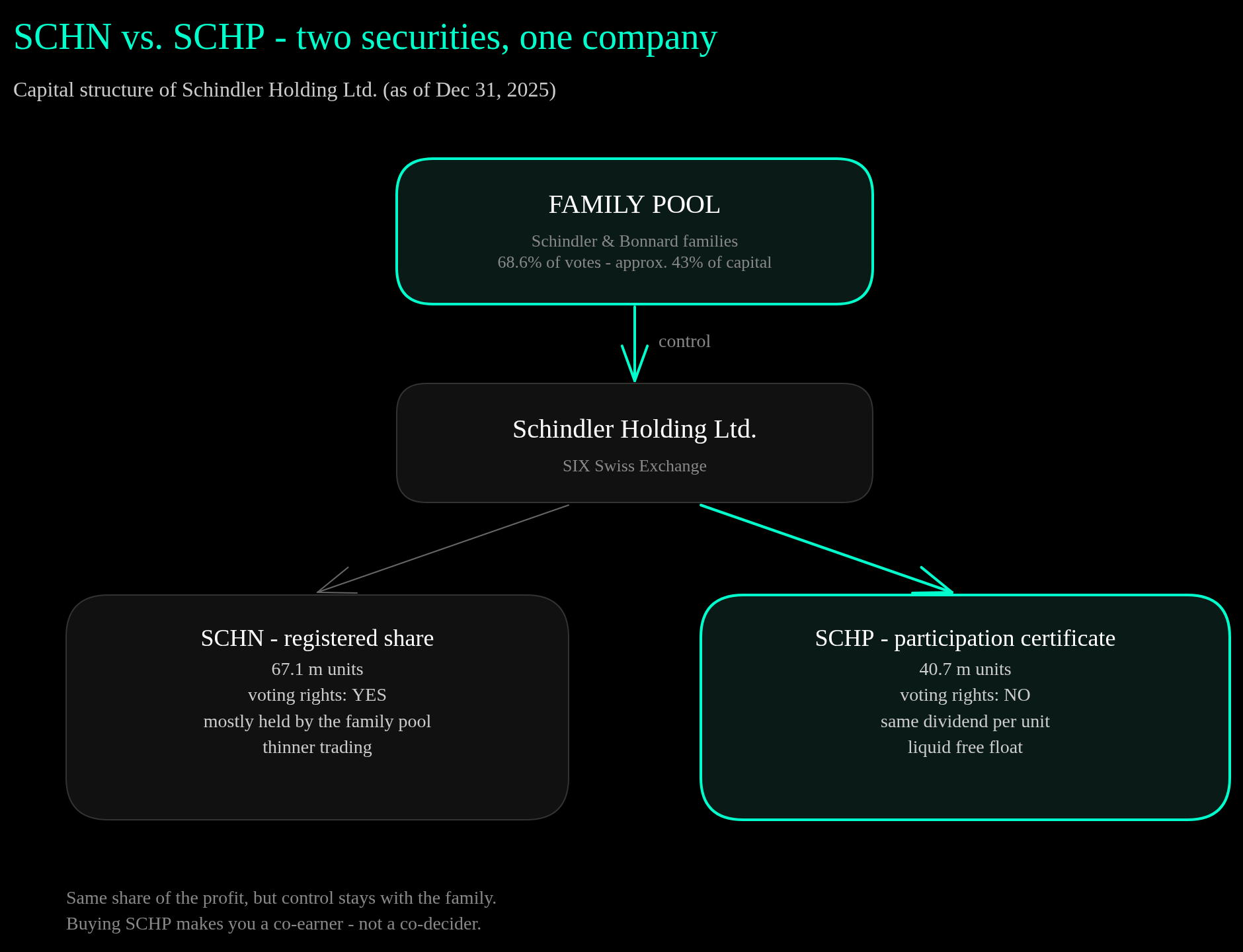
The capital structure: via their shareholder pool, the Schindler and Bonnard families control 68.6% of the voting rights with roughly 43% of the capital (as of Dec 31, 2025). ↗ Click to enlarge
The registered share SCHN (67.1 million units) carries the voting rights — and sits mostly in the family pool. The participation certificate SCHP (40.7 million units) has no voting rights, but exactly the same claim to dividends and liquidation proceeds per unit. Buying SCHP makes you a co-earner, not a co-decider. In exchange, the participation certificate is the more liquid free-float security. This analysis uses SCHP price data; the business figures apply to the whole group.
2) Business Model & Segments
Three business areas, one loop: sell new installations, service the installed base, modernize aging units.
- New installations — planning, production and first-time installation in residential, commercial and infrastructure projects. Currently the weakest link: China's new-construction market is shrinking structurally.
- Service & maintenance — ongoing maintenance and repair of the installed base. Recurring, high-margin, crisis-resistant — and legally mandated in most countries.
- Modernization — upgrading or replacing aging units. The structural growth driver: worldwide, more than 7 million units are considered outdated, and in Europe about half of all elevators are older than 20 years.
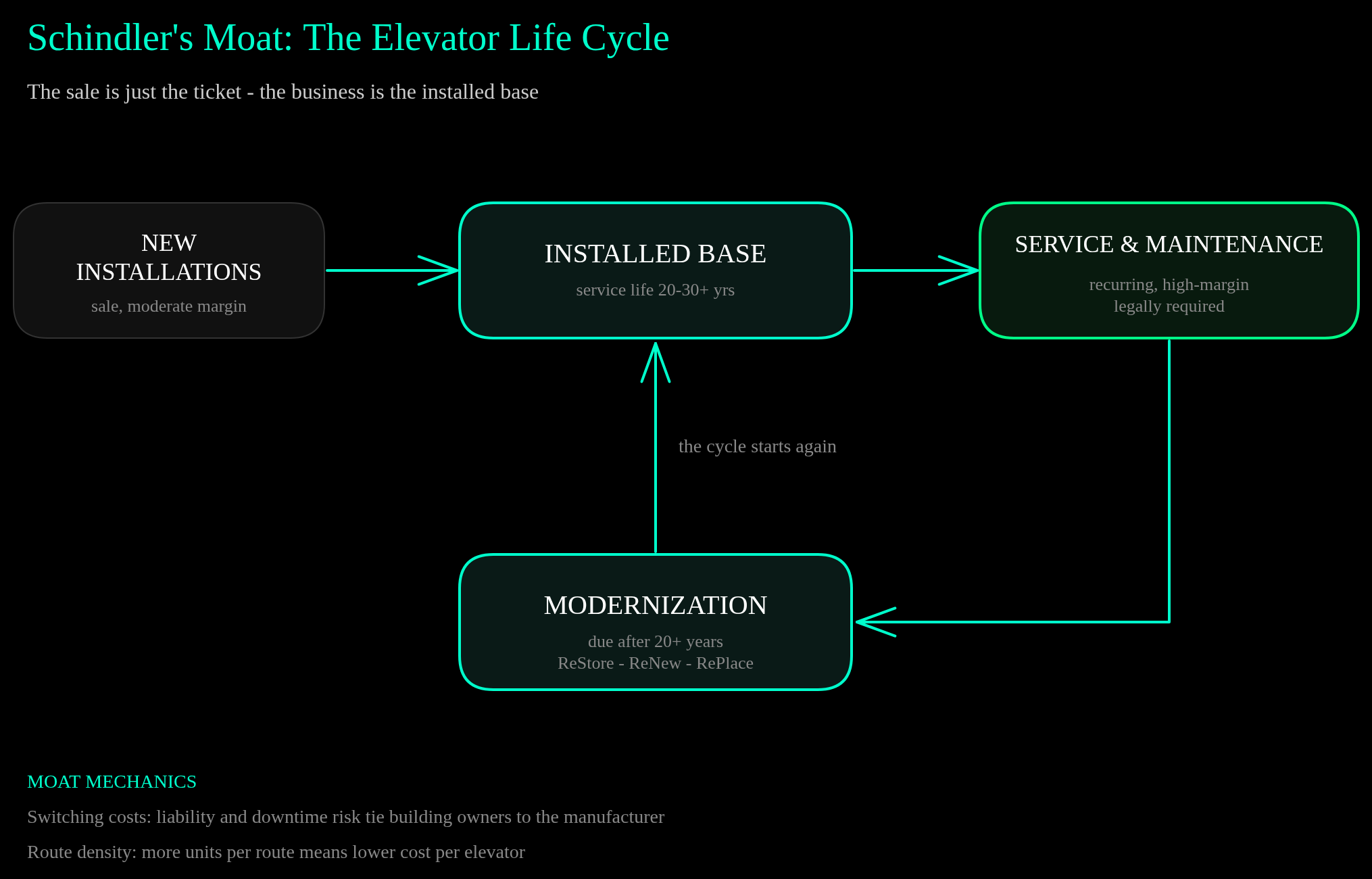
The life-cycle moat: the sale is the ticket, service and modernization are the business — protected by switching costs and route density. ↗ Click to enlarge
In 2025, Schindler generated revenue of CHF 10,947 million — 48% in EMEA, 29% in the Americas, 23% in Asia-Pacific. The largest single markets: USA (CHF 2,379 m), Switzerland (CHF 1,095 m), China (CHF 1,068 m). The workforce shows that Schindler is a service company at its core: 61% of its 67,381 employees work in installation and maintenance — directly on the units.
The moat has four layers: switching costs (liability and downtime risk tie building operators to the manufacturer), route density (the more units per route, the lower the cost per elevator — small competitors cannot keep up), technology (cloud-connected units, remote diagnostics via Technical Operations Centers, proprietary systems like the PORT transit management), and regulation (nobody switches to the cheapest provider for safety-critical infrastructure).
3) Growth & Development
| Year | Revenue | Net profit | EPS | EBIT margin |
|---|---|---|---|---|
| 2021 | CHF 11,236 m | 881 m | 7.70 | 10.4% |
| 2022 ▼ Low | CHF 11,346 m | 659 m | 5.67 | 8.0% |
| 2023 | CHF 11,494 m | 935 m | 8.05 | 10.3% |
| 2024 | CHF 11,236 m | 1,010 m | 8.83 | 11.3% |
| 2025 ▲ Record | CHF 10,947 m | 1,073 m | 9.48 | 12.6% |
The central reading: revenue looks flat — profit is surging. The nominal revenue decline in 2025 is almost entirely a currency effect: the strong Swiss franc alone cost around CHF 431 million of revenue in 2025; in local currencies, Schindler grew by 1.3%. Behind this ran a four-year operational recovery plan (2022–2025): after the 2022 slump caused by supply-chain bottlenecks, inflation and China lockdowns, management lifted the EBIT margin from 8.0% to 12.6% — pricing discipline, efficiency, and a better mix of service and modernization.
The first half of 2026 continues the trend: order intake CHF 5,794 m (+2.9% local), revenue CHF 5,329 m (+1.4% local), EBIT margin 13.2%, net profit CHF 542 m.
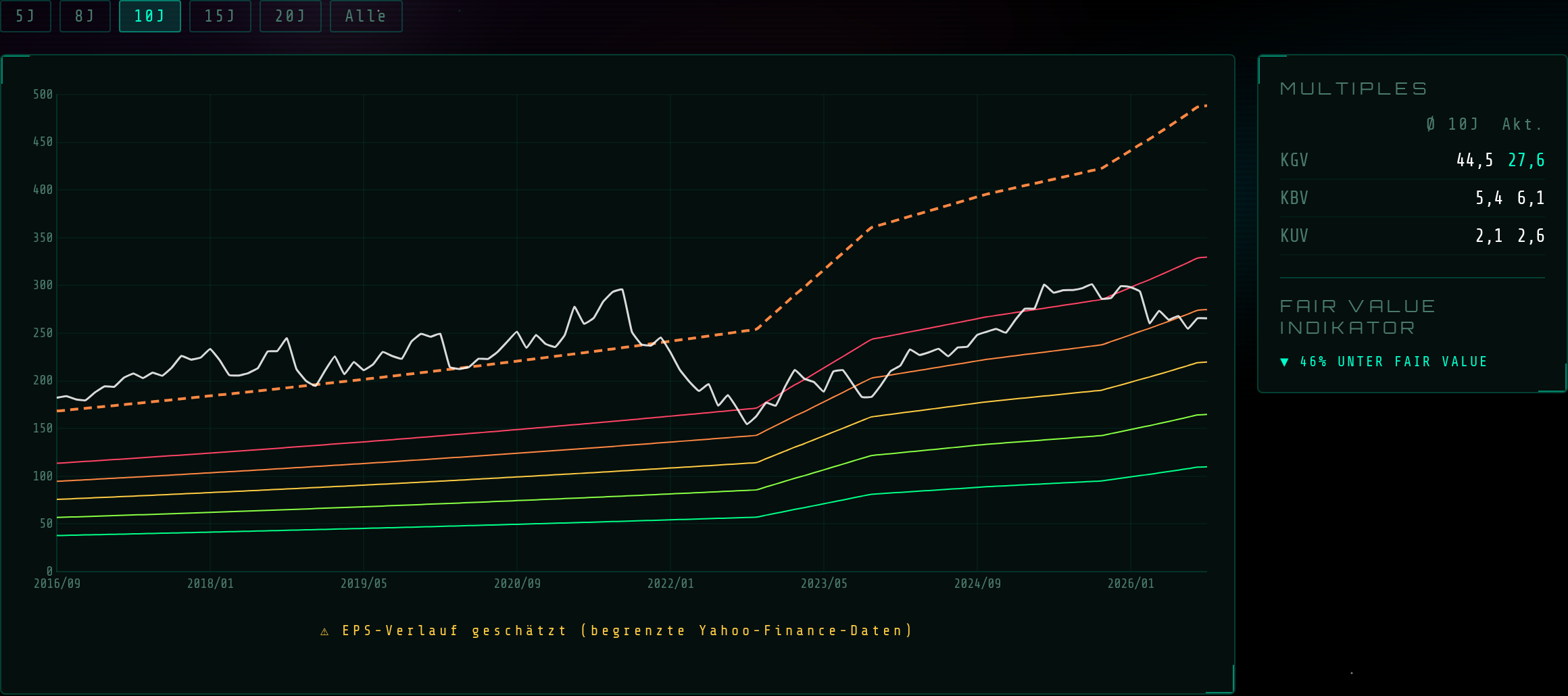
Alien Analyzer V2 — Fair Value tab (German UI): the price (white) against the fair-value bands. Caution: the 10-year average P/E of 44.5 is skewed upward by filtered outliers in the Yahoo data — read the "46% below fair value" indicator with care (more in section 6). ↗ Click to enlarge
4) Profitability & Balance Sheet
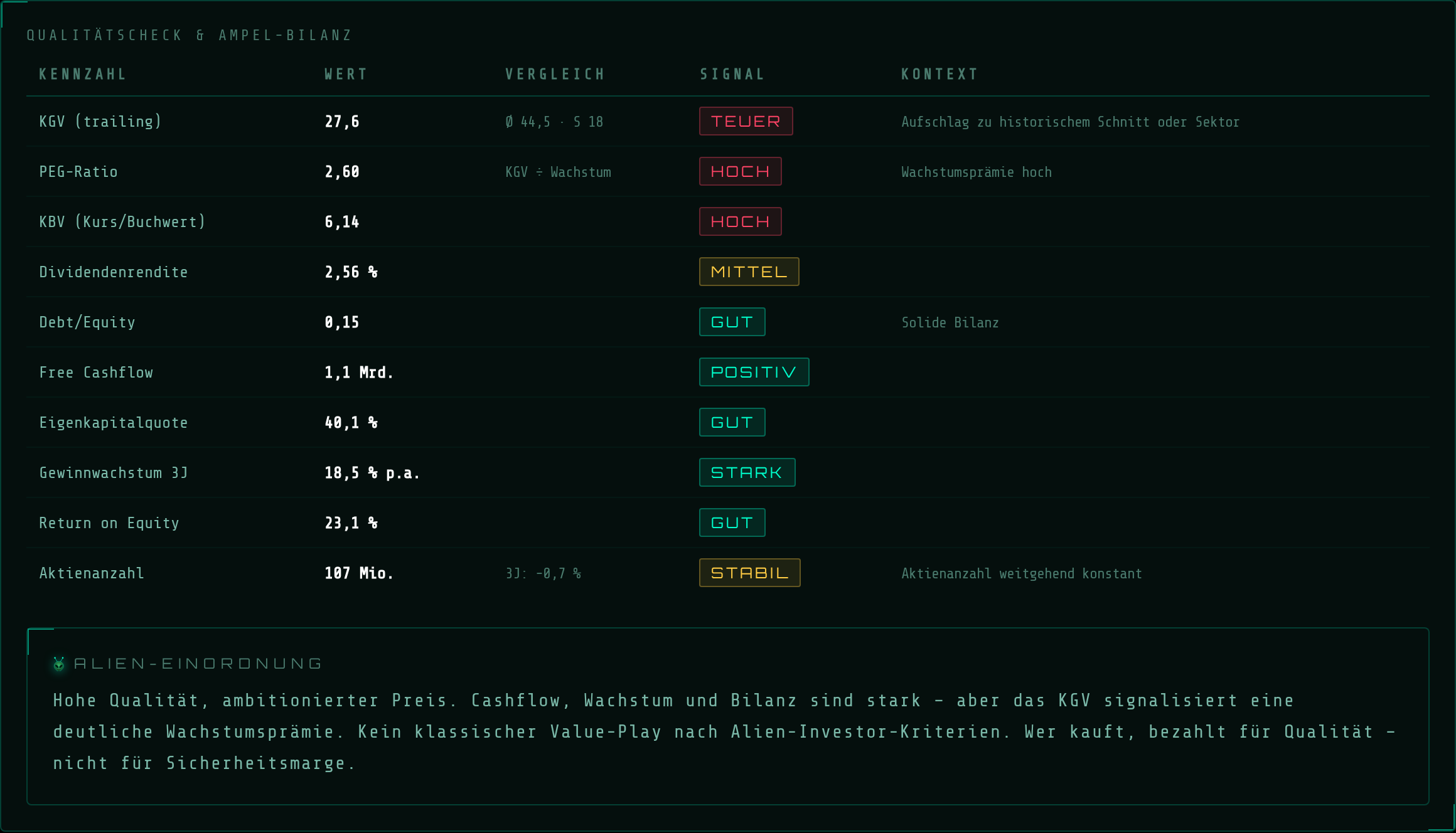
Alien Analyzer V2 — quality check (German UI): traffic-light overview of the key metrics with context. ↗ Click to enlarge
The balance sheet is the quiet part of this story: equity ratio 43.9% (2025 annual report), barely any financial debt (debt/equity ~0.13 including lease liabilities), operating cash flow of around CHF 1.5 bn in 2025 with minimal capex — a service business does not need expensive factories. Return on equity was around 21% in 2025. Data note: the analyzer screenshot shows Yahoo TTM values for equity ratio (40.1%) and ROE (23.1%) — the magnitude is right; the precise figures above come from the annual report.
On the dividend: for 2025, CHF 6.80 per unit was paid out (6.00 ordinary + 0.80 extraordinary), a yield of about 2.6%. More remarkable than the level is the pace: dividend growth ran at a good 11% p.a. over 5 years and almost 10% p.a. over 10 years — funded from growing profits, not from substance.
5) Strategic Themes
Modernization offensive: in 2025 Schindler introduced three modular packages — ReStore (targeted component upgrades), ReNew (comprehensive modernization), RePlace (full replacement). They are being rolled out globally in 2026 and minimize downtime in occupied buildings. Add the new elevator concept Schindler X8 (debut: Milan Design Week 2025): it needs no headroom, no pit and no load-bearing shaft, and runs on a standard power supply.
Digital service: the share of cloud-connected units in the maintenance portfolio rose by another 10% in 2025. Via its Technical Operations Centers, Schindler diagnoses faults remotely before the unit fails — predictive maintenance cuts costs and makes service contracts even stickier.
The KONE-TKE merger: in April 2026, KONE and TK Elevator announced their combination (TKE enterprise value: EUR 29.4 bn) — creating the world's largest elevator group. CEO Paolo Compagna is running a two-track strategy: he has announced antitrust scrutiny — while also seeing the chance, during years of integration, to win dissatisfied customers, recruit technicians, and buy assets the merging parties may have to divest for competition reasons.
Outlook 2026 (management guidance, reiterated in July): revenue growth in the low to mid single digits (local currencies), EBIT margin around 13.0% — the first half already came in slightly above at 13.2%. The market prices a forward P/E of about 24 [consensus per stockanalysis.com].
6) Valuation in Context
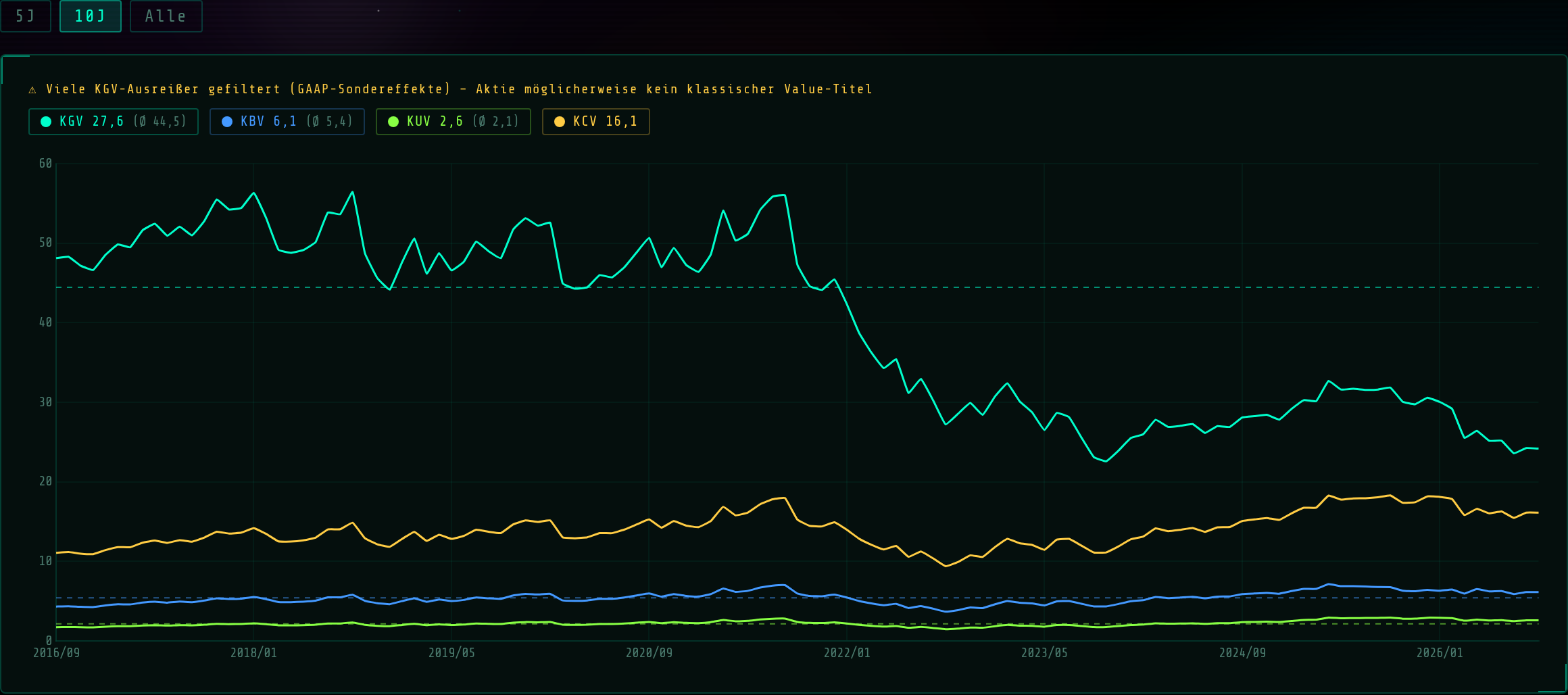
Alien Analyzer V2 — Multiples tab (German UI): P/E (27.6), P/B (6.1), P/S (2.6), P/CF (16.1) over 10 years. The tool itself warns: many P/E outliers filtered (GAAP one-offs). ↗ Click to enlarge
The P/E of 27.6 sits optically far below the 10-year average of 44.5 — which is where the fair-value indicator gets its "46% below fair value" from. That signal is too good to be true: the historical average is skewed upward by filtered GAAP outliers in the Yahoo data. A more honest look is the chart itself: since the margin recovery of 2022/2023, the P/E has oscillated roughly between 22 and 32. Today's 27.6 sits in the middle of that band — not bargain territory.
P/B (~5.5–6) and P/S (2.6, above the 2.1 average) tell the same story: you are paying for a capital-light quality business at record margins — not for undervalued substance. Model calculation (assumptions, not a forecast): if Schindler holds its guidance, around CHF 10 of EPS is achievable for 2026 [ESTIMATE based on H1 2026 — not verified from sources]. At a P/E band of 22–28, that would compute to CHF 220–280. The price of CHF 265.60 sits in the upper third of that range: fairly to slightly ambitiously valued.
Tool tip
The metrics in this analysis come from the Alien Analyzer V2 — my own stock screening tool. Fair value, multiples, dividends and quality check at a glance. Free, no login, no subscription.
alien-investor.org/alien-analyzer — enter a ticker, analyze.
7) Competitive Landscape & Moat
| Company | Origin | Revenue (latest) | Distinctive feature |
|---|---|---|---|
| Schindler (SCHN/SCHP) | Switzerland | CHF 10.9 bn (2025) | family control, 61% of staff in the field |
| Otis (OTIS) | USA | USD 14.4 bn (2025) | ~2.5 m units under maintenance — largest service portfolio |
| KONE (KNEBV) | Finland | EUR 11.2 bn (2025) | acquiring TKE (enterprise value EUR 29.4 bn) |
| TK Elevator | Germany | EUR 9.2 bn (FY 2024/25) | ex-thyssenkrupp, becoming part of KONE (closing pending) |
| Mitsubishi Electric | Japan | elevators as a sub-segment | strong in Japan and Asia |
The industry is an oligopoly of a few global manufacturers — and it is consolidating right now: KONE + TKE would combine to roughly EUR 20.5 bn of revenue and 3.2 million maintenance units, with about 65% of revenue from service and modernization. That would create a rival dethroning Otis and leaving Schindler clearly behind in size — and size matters in this business, because route density lowers cost.
Schindler's answer is not size but density and control: a family-controlled group that does not have to optimize for quarterly thinking, deeply rooted in its core markets. And the merger has a second side: years of integration at the rivals are historically the best opportunity to win customers and technicians — which is exactly what CEO Compagna has announced.
8) Customer Perspective
Schindler's customers are not consumers but developers, general contractors, property managers and the public sector. Customer loyalty is built on availability and response time: a stopped elevator in an office tower or hospital is a liability and reputation problem — which is why hardly anyone switches maintenance partners as long as the service works.
Public B2B customer ratings do not exist in evaluable form for this segment. [NOT AVAILABLE]
9) Employee Perspective
67,381 employees at the end of 2025, 61% of them in installation and maintenance. The bottleneck of the entire industry is qualified service technicians — whoever has them can grow the maintenance portfolio; whoever loses them loses contracts. The KONE-TKE integration is likely to shake up the technician market, and Schindler has openly declared it intends to recruit there. Systematically evaluable employer ratings across all markets: [NOT AVAILABLE]
10) Opportunities & Risks
11) Alien Verdict
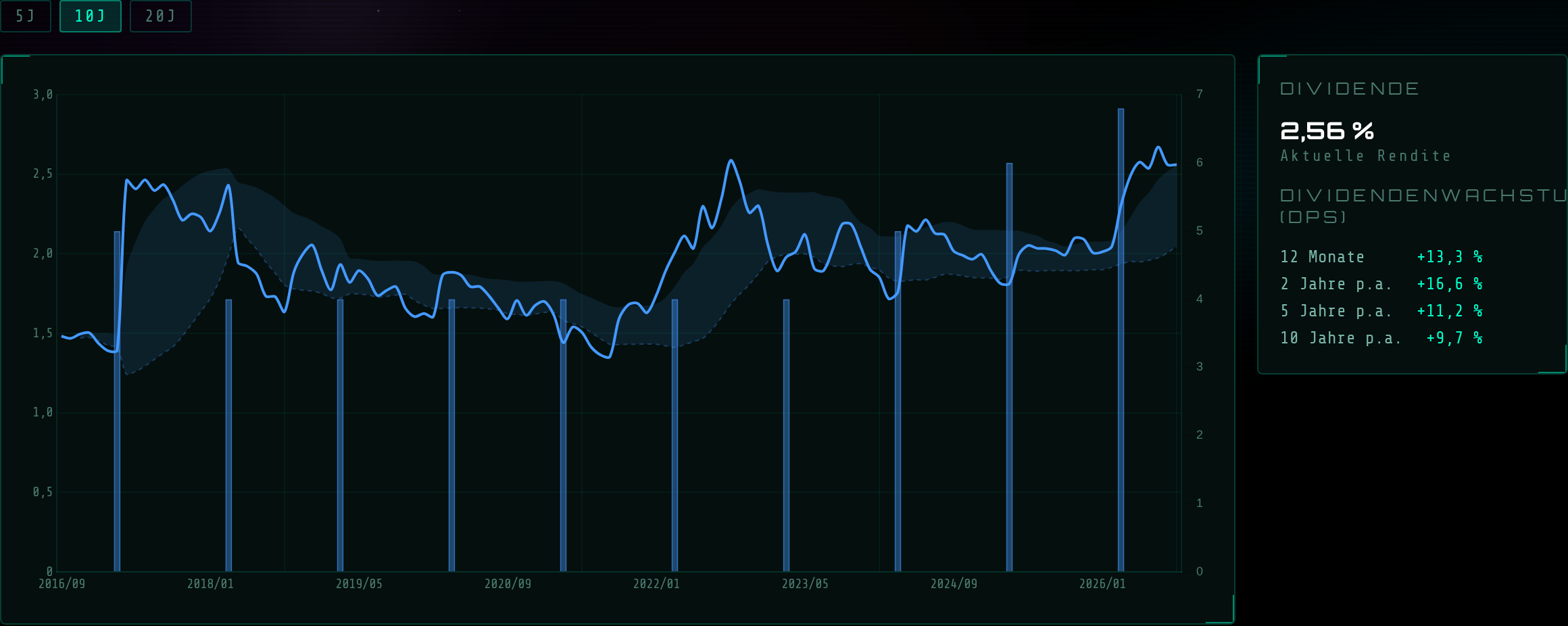
Alien Analyzer V2 — dividend tab (German UI): 2.56% yield, dividend growth +11.2% p.a. over 5 years, +9.7% p.a. over 10 years. ↗ Click to enlarge
Schindler is the opposite of a cyclical at its low: a quality company at record levels. The moat is real and multi-layered — switching costs, route density, technology, regulation. The installed base grows with every unit sold, and the modernization wave, especially in Europe, is not wishful thinking but the arithmetic of aging buildings.
Family control is both a feature and a constraint: it protects against short-term shareholder pressure and hostile takeovers — but whoever buys SCHP gives up any say and trusts that the Schindler and Bonnard families will keep deciding in the interest of all capital providers. The past decades argue they will.
The catch is the price. A P/E of 27.6 on record profits, P/B around 6, PEG 2.6 — there is no margin of safety in the valuation here, only in the quality. Whoever buys gets a high-margin service subscription with a growing dividend and accepts that returns must come from profit and dividend growth, not from a re-rating. No bargain. A watchlist candidate — interesting whenever the market once again grants this stock a P/E near 22.
"At Schindler you can buy quality any day — a discount almost never. Patience is the only margin of safety here."