"Water is the new oil." The line appears on ETF brochures, in sustainability reports and in every second megatrend report. For some, water scarcity is the investment opportunity of the century; for others it is one more green-painted sales pitch that fund companies use to justify a 0.65 percent annual fee. Both sides talk past each other because they mix up two things: the nature of water and the politics of the water price.
This analysis separates the two. First the measurable facts, then the question of who can earn money from them at all. After that, eight companies in the Alien Analyzer, a look inside Europe's largest water ETF and a list of what to avoid. From the perspective of a long-term co-owner, not a trend surfer.
"Water is not shipped like oil and not traded like copper. Whoever wants to buy water scarcity ends up buying pumps, membranes and meters. The rest is politics."
The scarcity is real but regional; the water price is political almost everywhere; so the money is made not on water but on the stages in between: by the equipment makers that supply pumps, meters, membranes and ultrapure water plants. Utilities are bond substitutes, conglomerates wear a label, and water rights are speculation.
Start with what can be measured. The World Resources Institute (WRI) uses its Aqueduct atlas to track how much of its available fresh water a country uses each year. The result of the 2023 update: 25 countries, home to a quarter of the world's population, use at least 80 percent of their available supply. That is the definition of "extremely high water stress". Around four billion people, at least half the world's population, experience such conditions for at least one month a year. Global water demand has more than doubled since 1960 and is projected to rise a further 20 to 25 percent by 2050.
The decisive point, however, is in the distribution: in the Middle East and North Africa, 83 percent of the population lives under extremely high stress, in South Asia 74 percent. In Central Europe, Scandinavia or Canada the figure is close to zero. Water is not a global commodity like oil, which travels the world in tankers and costs the same in Rotterdam as in Singapore. Water is heavy, cheap per litre and cannot be transported economically across continents. Scarcity is therefore always local: a river system, an aquifer, a region.
The quiet part: groundwater. The largest study on the subject (Jasechko et al., Nature, January 2024) evaluated around 170,000 monitoring wells in 1,693 aquifer systems in more than 40 countries. In 36 percent of the aquifers, levels are falling by more than ten centimetres a year, and in 30 percent the decline is accelerating in the 21st century, more than twice as often as chance would predict. But: in 16 percent of the systems the trend of the 1980s and 1990s has reversed. Tucson, Arizona deliberately recharges its aquifer with water from the Colorado River. That is not a law of nature, it is management. Where someone acts, the curve turns back up.
Who uses the water? According to the FAO database AQUASTAT (2025 edition), around 72 percent of global freshwater withdrawals go to agriculture. Industry and households share the rest. Whoever talks about water scarcity is, to three quarters, talking about irrigation. A note on honesty: a paper published in 2025 points out that this widely cited 70 percent rests on a thin empirical basis and is more convention than measurement. The order of magnitude is right, the decimal is not.
The case study: Colorado River. In August 2025 the US Bureau of Reclamation set the operating conditions for 2026: Lake Mead is projected at around 1,056 feet on 1 January 2026, which is the "Level 1 Shortage" tier. Arizona must give up 512,000 acre-feet (18 percent of its apportionment), Nevada 21,000 (7 percent), Mexico 80,000 (5 percent). Lake Powell sits 162 feet below full pool. And the rules by which the water is divided between seven US states and Mexico expire at the end of 2026. The water is not getting more; the negotiation over it is getting harder.
This is the part the brochures leave out. Oil has a world market price, copper has the LME, wheat has Chicago. Water has a city council. In almost every country in the world, the price of drinking water is not formed on a market but set by municipalities, regulators or ministries. And that price usually does not even cover the cost.
The OECD ran the numbers for the EU in 2024: on average, water tariffs cover around 70 percent of the financial cost of water services, with the remaining 30 percent coming from public budgets. Only a third of member states reach cost recovery of 100 percent or more; another third is below 90 percent. Environmental and resource costs, i.e. the price of pumping an aquifer dry, are not even included. In its landmark study on water pricing, the OECD writes that very few countries have even attempted to reflect the full economic and environmental costs in the price.
For a channel that deals with Bitcoin and market prices, this is the core: a good without a market price sends no scarcity signals. If a litre of water costs the same in the desert as on Lake Constance, there is no incentive to save it where it is missing. The "water crisis" is to a large extent a price crisis. It arises not because water runs out but because it is given away where it is scarce. That is neither a left-wing nor a green insight, just plain price theory.
Australia shows that it can be done differently. In the Murray-Darling Basin, water entitlements and annual allocations have been traded for decades. According to the Murray-Darling Basin Authority, water rights worth around 4 billion Australian dollars change hands there every year, 97 percent of all Australian allocation trade. The water flows to where it earns the highest return: from the rice farm to the almond orchard. A market price for water is therefore possible. It is just almost nowhere politically wanted.
What does that mean for the investor? Whoever buys a stock because "water is getting scarcer" is betting that scarcity translates into price. For the end product water, it almost never does. It translates into something else: capital expenditure. Whoever has less water has to pump it deeper, clean it better, measure it more precisely, reuse it or take it from the sea. The money does not flow to the water, it flows to the technology.
The interesting demand does not come from climate conferences but from four directions that have nothing to do with ideology. They have one thing in common: someone is forced to spend money.
Ageing networks and lead pipes (USA). In October 2024 the US Environmental Protection Agency (EPA) issued the "Lead and Copper Rule Improvements": all water systems must replace their lead service lines within ten years. The EPA puts the cost at 1.47 to 1.95 billion dollars a year, of which 1.17 to 1.64 billion for the line replacement alone, and the benefits at up to 25 billion dollars a year. 15 billion dollars from the infrastructure law are earmarked for exactly this replacement. How many lines there are is tellingly unclear: the EPA survey of 2023 counted 9.2 million, the new EPA dashboard from November 2025 only around 4 million, but with around 24 million lines of "unknown material". Whichever number is right: every one of those lines needs pipes, fittings, meters and labour hours.
PFAS regulation. In April 2024 the EPA set the first binding limits for "forever chemicals" in drinking water: 4 nanograms per litre for PFOA and PFOS. Around 66,000 water systems must monitor, 4,100 to 6,700 of them (6 to 10 percent) will have to build treatment. Cost according to the EPA: around 1.5 billion dollars a year. In May 2026 the EPA proposed extending the PFOA and PFOS deadline from 2029 to 2031. Extended, not abolished. Filters, activated carbon, membranes, analytics: all equipment business.
Chip fabs. A modern semiconductor fab is a waterworks with lithography attached. TSMC reports water consumption of 129 million cubic metres for 2024 (2023: 114 million), around 161 litres per wafer layer. The company built its own reclamation plants in Tainan, which delivered over 19.65 million cubic metres of reclaimed water by the end of 2024 and replaced 17 percent of fresh water there. TSMC rates its own Arizona site as a "high-risk area" for water. Whoever builds there buys ultrapure water plants in the hundreds of millions. That is why a Japanese water chemistry company like Kurita is now traded like a semiconductor supplier.
AI data centers. In December 2024 the Lawrence Berkeley National Laboratory did the maths for the US Department of Energy: direct water consumption of US data centers (mainly evaporative cooling) rose from 21.2 billion litres in 2014 to 66 billion litres in 2023. Hyperscalers alone are expected to consume between 60 and 124 billion litres in 2028. On top comes indirect consumption via electricity generation, around 800 billion litres in 2023. Power demand grows from 176 terawatt-hours (4.4 percent of US consumption) to 325 to 580 terawatt-hours in 2028. Xylem, Watts and Ecolab now explicitly name data centers as growth drivers. Except: that is an AI investment with a water connection, not a scarcity investment.
Agriculture. Three quarters of the water goes to the field. Where groundwater falls and allocations are cut, the farmer has to get more yield per litre: center pivot irrigation with sensors instead of flood irrigation. That is the most direct link to scarcity in the whole universe. And at the same time the most cyclical, because the farmer buys the system only when wheat prices and farm income are right.
Whoever wants to buy the trend conveniently reaches for an ETF. The largest in Europe is the iShares Global Water UCITS ETF on the S&P Global Water Index: around 2.2 billion US dollars in assets, 66 holdings, 0.65 percent annual fee (factsheet as of 31 August 2026). A look at the composition is sobering.
Source: justETF (sectors, 30 Jul 2026) and iShares factsheet (31 Aug 2026). Top 10 = 55.3% of the fund.
Almost half of the "water trend" consists of regulated utilities: American Water Works (8.2 percent), SABESP from Brazil (6.7 percent), Essential Utilities, United Utilities, Severn Trent. These are territorial monopolies whose profit is set by a regulator. They do not earn more when water gets scarcer; they earn an approved return on their invested capital. A quarter of the fund hangs on the United Kingdom and Brazil, two countries where water regulation is politically hot right now. And the rest? Xylem as a pure equipment maker (7.8 percent), but also Veralto, Ecolab, Geberit and Watts Water, where either water is only half the business or the construction cycle drives demand, as we will see shortly.
In short: whoever buys this ETF buys 45 percent bond substitute with regulatory risk, 35 percent industrials with a construction cycle and 15 percent chemicals. That can be a reasonable defensive addition. A lever on water scarcity it is not.
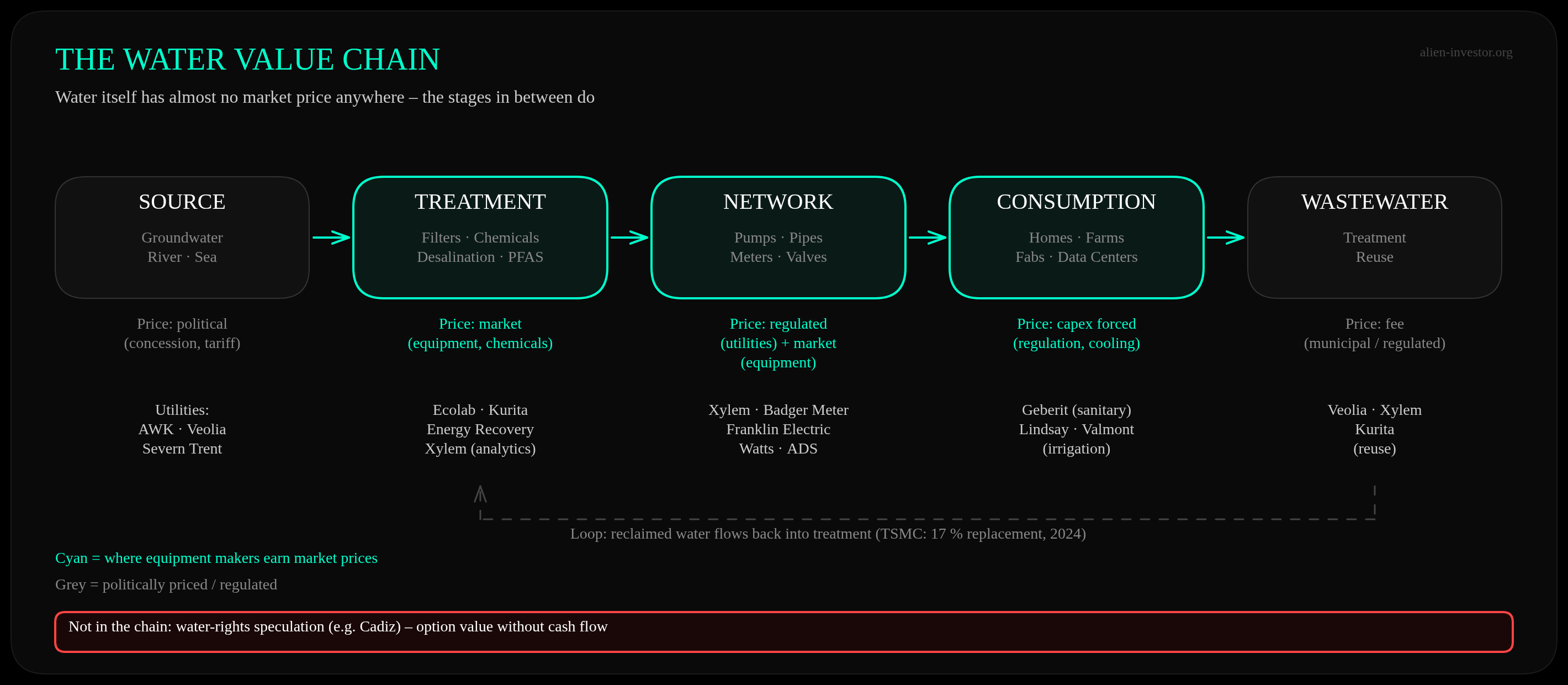
To understand who profits, it helps to follow the water from source to drain. A different price regime applies at every stage.
Five stages, two price regimes: at source and drain, politics sets the price; in between, equipment makers sell at market prices. ↗ Click to enlarge
At the source (concession, water right) and at the drain (municipal fee), the state sets the price. In the middle, in treatment, network and consumption technology, there is competition and a market price. That is where the companies with pricing power, spare parts business and service contracts sit. And that is where demand is least ideological: a PFAS treatment plant gets built because a limit applies, not because someone believes in climate change.
| Category | Lever on scarcity | Core argument |
|---|---|---|
| Equipment makers (pumps, meters, analytics) | ✅ Yes | Capex forced by regulation and network age, market prices, spare parts and service business |
| Ultrapure / industrial water | ✅ Yes, indirectly | Chip fabs and data centers pay any price for purity; the driver, however, is the chip cycle |
| Desalination | ⚠️ Possible | Technically the most direct scarcity play, but dependent on a few state-funded megaprojects |
| Irrigation | ⚠️ Possible | 72 percent of water goes to the field, but the farmer buys on farm income, not on drought |
| Regulated utilities | ⚠️ No lever | Approved return on rate base; scarcity tends to cut volumes (conservation mandates); bond substitute |
| Sanitary / building technology | ❌ Label | Geberit, Watts, Advanced Drainage: products carry water, demand follows the construction cycle |
| Conglomerates with a water label | ❌ Label | Veolia 40 percent water, Ecolab 50 percent, Valmont 21 percent: the rest is waste, hygiene, utility poles |
| Water rights | ❌ Speculation | Cadiz: 30 years of project, 712 million USD accumulated deficit, option value without cash flow |
This is the category the analysis lands on once the labels are peeled off. The companies here sell to utilities, industry and well drillers at market prices, have installed bases and live from replacement and service business. The flip side: the market knows this and pays for it.
With 9.0 billion dollars in revenue (2025, up 5.5 percent), Xylem is the largest listed company that sells nothing but water technology: pumps and treatment for utilities (Water Infrastructure, 2.6 billion), building and industrial pumps (Applied Water, 1.8 billion), meters and network analytics (Measurement & Control, 2.1 billion) and, since the Evoqua acquisition in 2023, a services business with mobile treatment (Water Solutions & Services, 2.5 billion). All four segments are water. The only blur: the metering business also includes gas and electricity meters, whose share is not disclosed.
The current picture is less shiny than the story. In the second quarter of 2026 revenue grew only 2 percent (1 percent organic), while adjusted earnings per share rose 16 percent to 1.46 dollars. The company expects around 9.2 billion in revenue and 5.55 to 5.70 dollars in earnings per share for 2026. The stock has lost about a quarter from its high, so growth is being repriced right now.

Xylem in the Alien Analyzer: solid balance sheet, strong earnings growth, but a P/E of 26 and a share count up 35 percent in three years. Tool screenshots are in German. ↗ Click to enlarge
Two things in the quality check need context. First: the historical average P/E of 56 is distorted by exceptional years with depressed earnings; the honest comparison is the current P/E of 26 against 5 percent organic growth. That is a quality premium, not a margin of safety. Second: the 35 percent dilution comes from the Evoqua acquisition, which was paid entirely in shares. That was a deliberate swap of equity for business, not a need for capital, and since the merger Xylem has been buying back: as of July 2026 there were 233.5 million shares instead of 244 million at the end of 2025. Still relevant for the owner: the pie is bigger, the slice is smaller.
When groundwater levels fall, wells have to go deeper and pumps have to get stronger. Franklin Electric from Indiana is the world market leader in submersible pumps and motors for exactly those wells: households, agriculture, municipalities. In 2025 the company posted 2.13 billion dollars in revenue (up 5.4 percent), of which 1.26 billion in the Water Systems segment and 0.70 billion through its own well drilling distribution business. The third segment, fuel pumps for petrol stations (0.30 billion), has nothing to do with water; but around 85 percent of the business depends on groundwater.
In the second quarter of 2026 revenue grew 6 percent to 623 million dollars, adjusted earnings per share 18 percent to 1.55 dollars, and the 2026 guidance was raised to 2.21 to 2.29 billion in revenue. The balance sheet is almost debt-free (debt/equity 0.22), the share count is falling slightly.
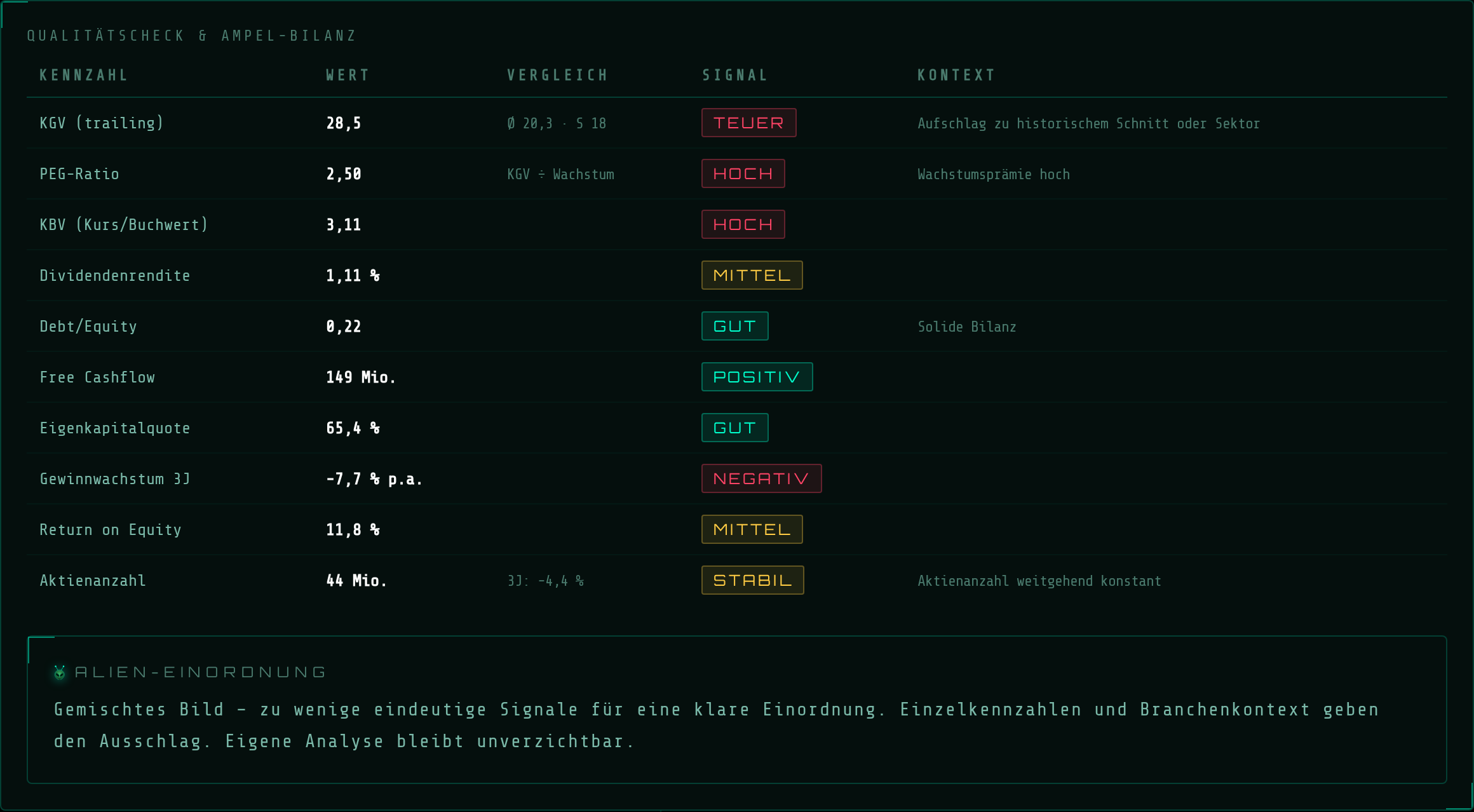
Franklin Electric: textbook balance sheet, but the P/E of 28.5 sits well above its own ten-year average of 20. ↗ Click to enlarge
The catch is the cycle. Demand for well pumps depends on US housing and on the weather, both explicitly listed as risks in the quarterly release. The negative three-year earnings growth in the Analyzer is partly a one-off (pension settlement in 2025 with 55 million dollars in charges), but organically revenue has stagnated since 2022. Whoever buys here buys the "deeper wells" thesis at the price of a growth stock.
| Company | Ticker | Water share | Profile |
|---|---|---|---|
| Xylem | XYL / NYSE | ~100% | Largest pure water technology company. P/E 26, near net-cash balance sheet. Organic growth down to 1 to 5 percent. |
| Franklin Electric | FELE / Nasdaq | ~85% | World leader in well pumps. Almost debt-free. ⚠ Housing and weather cycle. |
| Badger Meter | BMI / NYSE | ~86% | Water meters plus reading software, 33 years of dividend increases, effectively debt-free. ⚠ 2026 revenue "flattish" at P/E 30, stock down 30 percent. |
| Watts Water | WTS / NYSE | ~100% buildings | Valves and controls for buildings, Q2 2026 up 19 percent on data centers. P/E 31.5: AI expectations priced in. |
| Advanced Drainage | WMS / NYSE | 100% storm/wastewater | Plastic pipes replacing concrete, 36 percent EBITDA margin. Profits from heavy rain, not from drought. |
Kurita from Tokyo does nothing but water treatment: chemicals, plants and operating contracts. Half the business is classic industrial water (boilers, cooling, wastewater), the other half ultrapure water for semiconductor fabs in Japan, Korea, Taiwan, the US and Europe. In the first quarter of its fiscal year (April to June 2026) revenue grew 14 percent to 99.9 billion yen, of which 45.9 billion from the electronics segment. Order intake rose 77 percent to 165.7 billion yen, driven by large orders in the US and Taiwan. For the full year Kurita expects 425 billion yen in revenue.
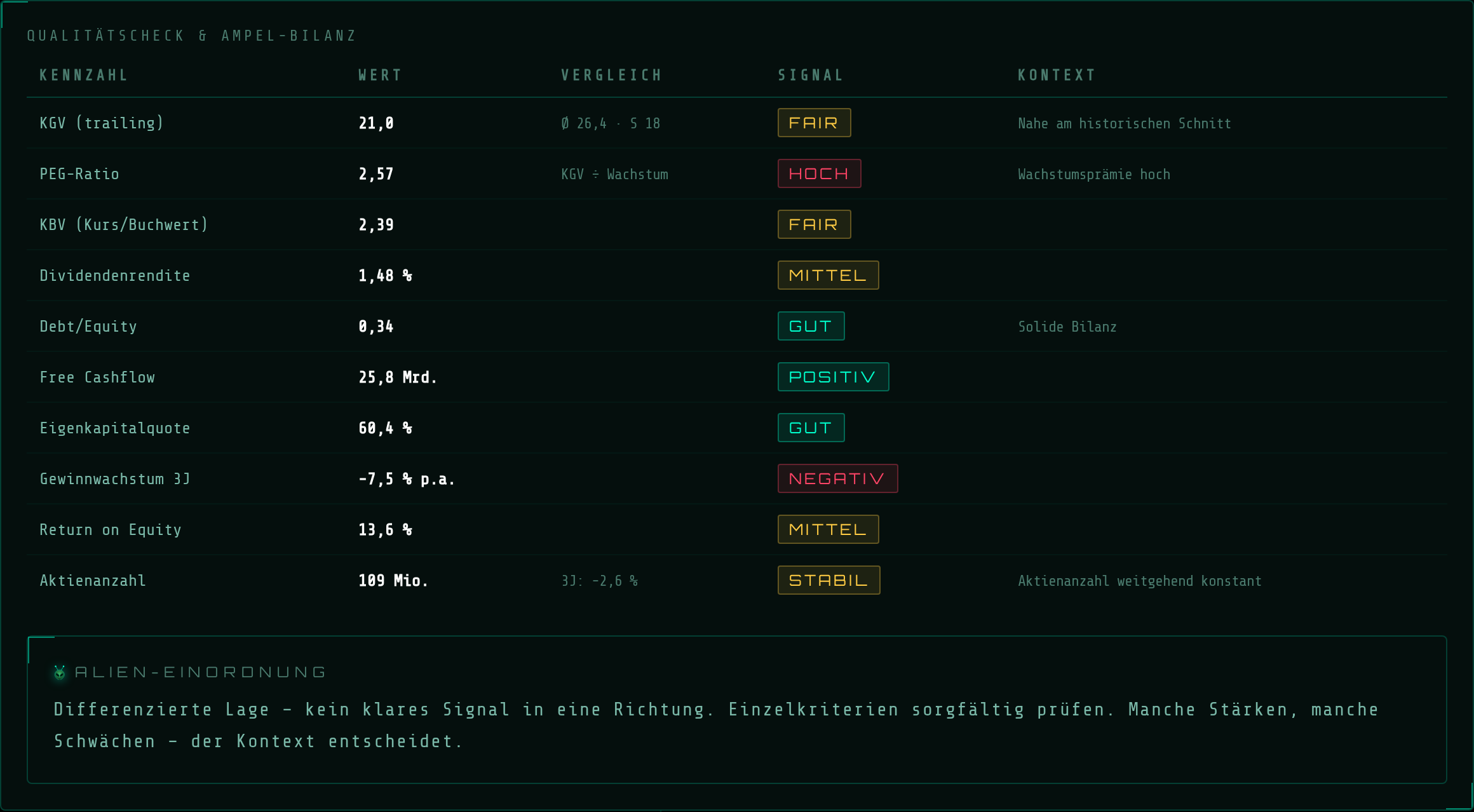
Kurita: P/E 21 close to its own average, solid balance sheet, buybacks. Figures in yen. The negative three-year earnings growth stems from one-offs in fiscal 2025/26. ↗ Click to enlarge
Kurita is the proof of this analysis's thesis: the price of water plays no role here, the price of purity does. A chip fab pays what it costs. The risk lies elsewhere: the electronics segment margin fell to 8.9 percent in the quarter (prior year 12.3) because large projects carry start-up costs, and the yen swings. Whoever buys Kurita buys the semiconductor capex cycle with a water connection. That is a good position, but you should know what you hold.
If there is a pure scarcity play, this is it. Energy Recovery from California builds pressure exchangers (PX Pressure Exchanger) which, according to the company, save up to 60 percent of the energy in seawater desalination plants. Without desalination there would be no drinking water in Saudi Arabia and the Emirates. The gross margin of 75 percent in the latest quarter (around 65 percent for full-year 2025) shows how strong the technology is.
And yet revenue collapsed 57 percent to 12.0 million dollars in the second quarter of 2026: the megaprojects in the Gulf were postponed because of the Iran conflict and financing problems, and the business with plant builders fell by more than 80 percent. The company posted a quarterly loss of 3.2 million dollars and withdrew its full-year guidance. The stock has lost almost half its value within twelve months. The company has around 98 million dollars in cash and no debt, so it will not disappear. But it lives off a handful of state-funded contracts.
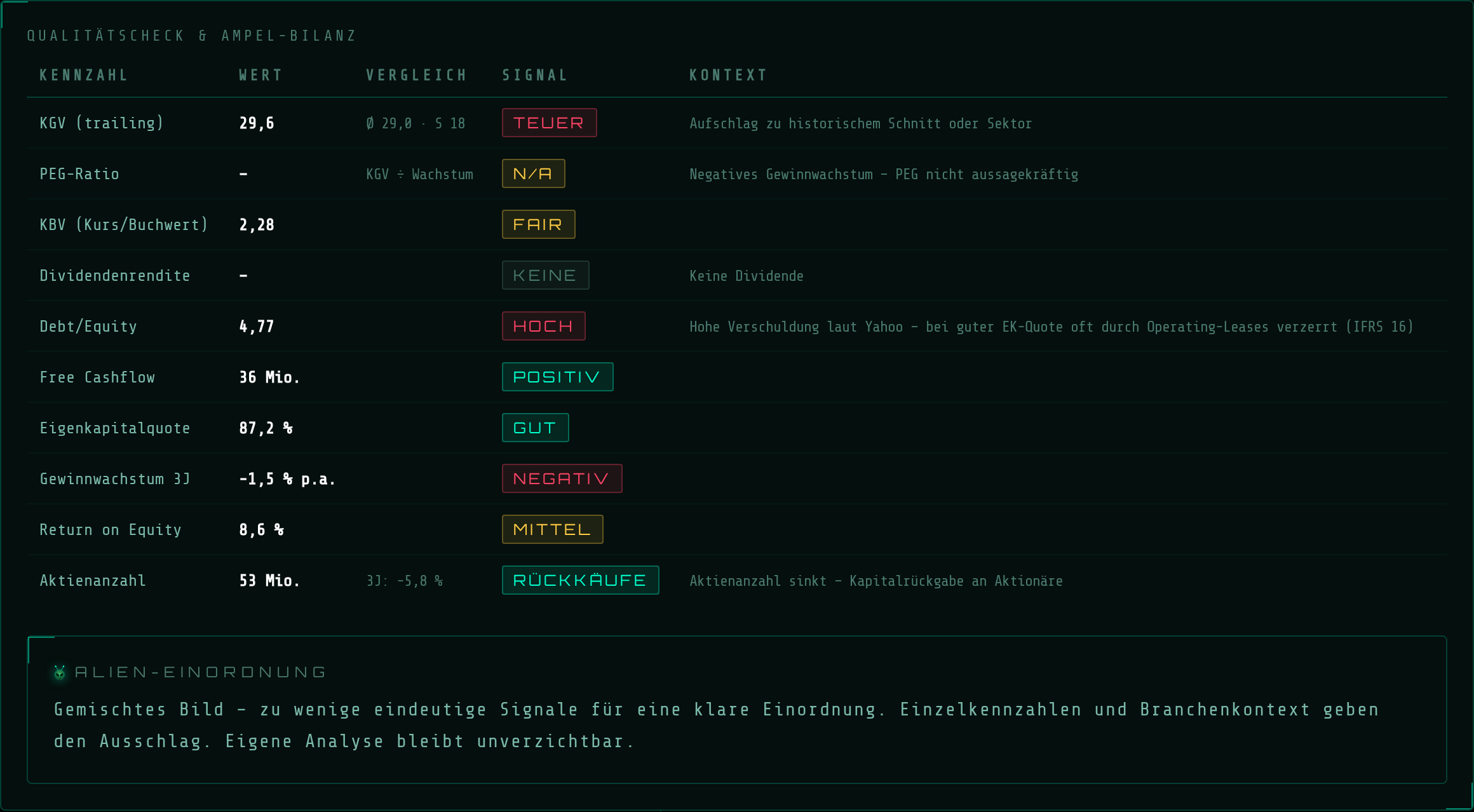
Energy Recovery: equity ratio 87 percent, buybacks, but negative earnings growth. The debt/equity of 4.8 is a data error at Yahoo Finance; according to the balance sheet the company holds net cash. ↗ Click to enlarge
The lesson is uncomfortable: exactly where water is scarcest, the state pays for the plants. And states build when the oil price and geopolitics allow it, not when the aquifer demands it. The purest scarcity play is thus the most volatile name on the list.
| Company | Ticker | Water share | Profile |
|---|---|---|---|
| Kurita Water | 6370 / Tokyo | 100% | Ultrapure water for chip fabs plus industrial water. Order intake up 77 percent. ⚠ Semiconductor cycle, yen, thin net margin. |
| Energy Recovery | ERII / Nasdaq | ~100% | Energy recovery for desalination, 65 to 75 percent gross margin, net cash. ⚠ Revenue down 57 percent, concentration risk Gulf region. |
| Ecolab | ECL / NYSE | ~50% | Industrial water chemistry is half, the rest hygiene, pest control, pharma. Acquisitions Ovivo (ultrapure water) and CoolIT (data center cooling). P/E 37. |
Lindsay builds center pivot irrigation systems (Zimmatic) with remote control and sensors (FieldNET). Around 83 percent of revenue comes from irrigation, the rest from road safety technology. That is water efficiency in the field, where three quarters of the water is used. There are only two large suppliers of this technology worldwide, Lindsay and Valmont.
The fiscal year shows the cycle in its purest form: in the third quarter (to the end of May 2026) revenue fell 5 percent to 161 million dollars, irrigation in North America by 11 percent, because weak crop prices are holding farmers back. A large project in the Middle East (around 70 million dollars in revenue in the fiscal year) is winding down. Earnings per share fell to 1.53 dollars (prior year 1.78).

Lindsay: healthy balance sheet, only 11 million shares, but a P/E of 24 at 4 percent earnings growth. The market pays for the drought story; farmers pay according to the wheat price. ↗ Click to enlarge
That is the dilemma of irrigation: the link to scarcity is as direct as nowhere else, but the customer buys on farm income. Drought raises the need and lowers purchasing power at the same time. For the long-term owner, Lindsay is a solid company with a small share count that you look at in agricultural troughs, not in drought headlines.
| Company | Ticker | Water share | Profile |
|---|---|---|---|
| Lindsay | LNN / NYSE | ~83% | Center pivots plus sensors. Solid balance sheet, 11 million shares. ⚠ Agricultural cycle, project concentration Middle East. |
| Valmont | VMI / NYSE | ~22% | The other pivot supplier (Valley), but 78 percent of revenue is steel poles for power grids. A grid build-out stock with an irrigation appendix. |
American Water Works is the largest listed water utility in the US: around 14 million people in 14 states. In 2025 revenue rose 9.7 percent to 5.14 billion dollars, net income was 1.11 billion. The company is investing around 3.7 billion dollars in networks in 2026 and aims to grow earnings and dividend by 7 to 9 percent a year over the long term. The merger with Essential Utilities, announced in October 2025 and approved by shareholders in February 2026, makes it bigger still.
The business model is simple and has nothing to do with scarcity: the utility invests in pipes, the regulator approves a return on that invested capital (the "rate base"), and customers pay the tariff. More investment means more approved profit. Less water means, if anything, lower volumes because conservation mandates kick in. The lead pipe replacement and the PFAS rule from section 3 are therefore not a cost problem for AWK but growth in the rate base.
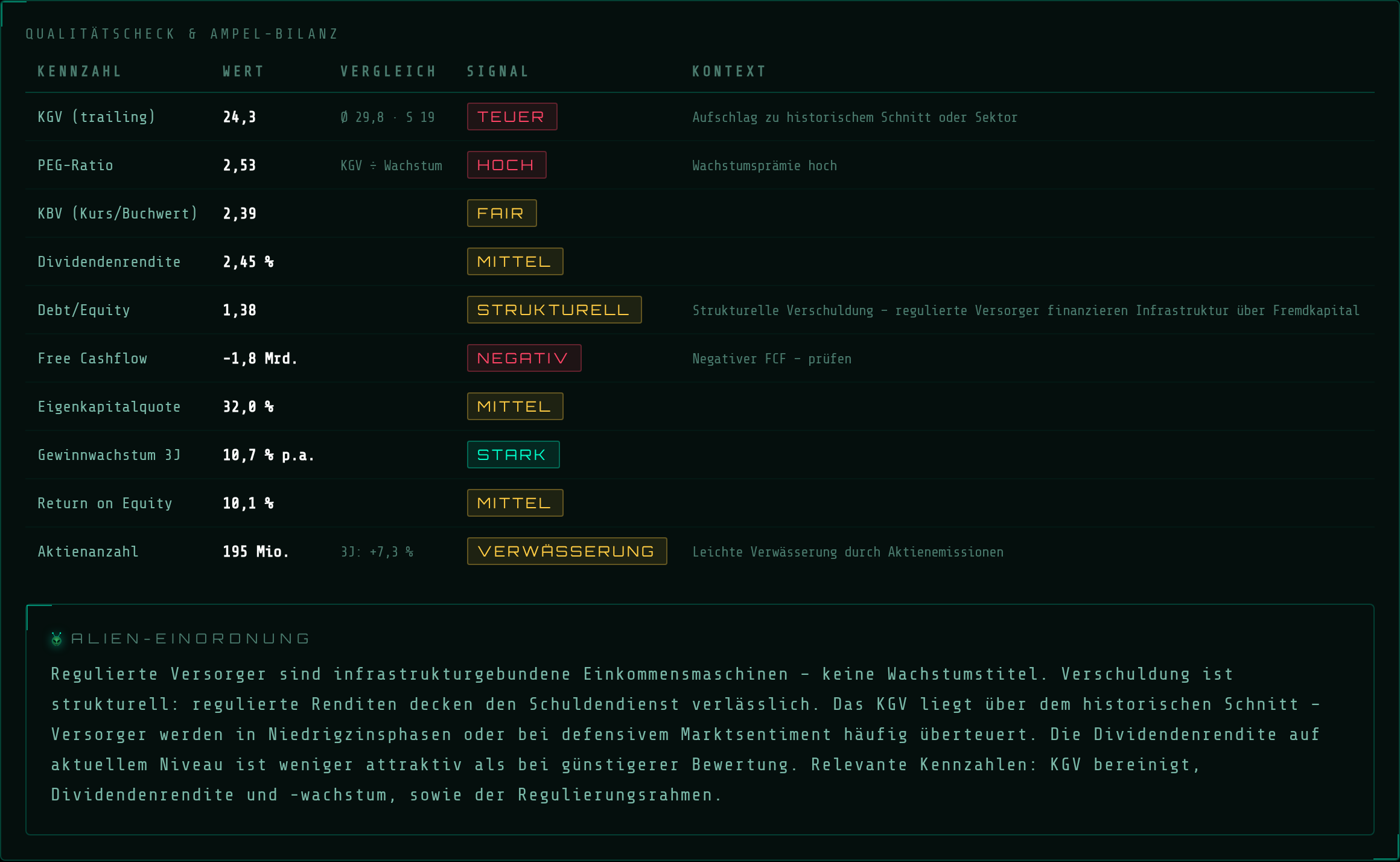
AWK: negative free cash flow, structural debt, ongoing share issuance. Normal for a regulated utility, the wrong tool for a "scarcity play". ↗ Click to enlarge
The Analyzer shows it honestly: free cash flow is deeply negative at minus 1.8 billion dollars because every dollar of profit and then some goes into pipes; that is financed through debt (net debt around 5.5 times EBITDA) and share issuance. Return on invested capital is around 4.6 percent, i.e. only as high as the regulator allows. At a P/E of 24 and a 2.5 percent dividend yield you are buying a regulated bond with a growth clause. That can make sense. It just is not a water investment in the sense of this analysis, and it gets expensive when rates rise.
| Company | Ticker | Water share | Profile |
|---|---|---|---|
| American Water Works | AWK / NYSE | ~100% regulated | Largest US water utility, 7 to 9 percent target growth, merger with Essential Utilities. ⚠ Negative FCF, net debt/EBITDA 5.5, interest rate risk. |
| Severn Trent | SVT / London | ~93% regulated | English Midlands, 4.2 percent dividend at a payout ratio near 100 percent. ⚠ Adjusted net debt 10 billion pounds, regulatory pressure on the UK water industry. |
Two European names sit in almost every water fund. Both are good companies. Neither is a water investment.
Since the Suez merger of 2022, Veolia is the world's largest environmental services company with 44.4 billion euros in revenue (2025) and over 200,000 employees. The water business (concessions, operations, water technology) brings in 17.7 billion euros, i.e. 39.9 percent. The rest is waste (15.4 billion, 34.8 percent) and energy, mainly district heating (11.3 billion, 25.4 percent). The latest acquisitions (Clean Earth, hazardous waste in the US, around 3 billion dollars) shift the weight further away from water. The water technology division even shrank by almost 5 percent in the first half of 2026.
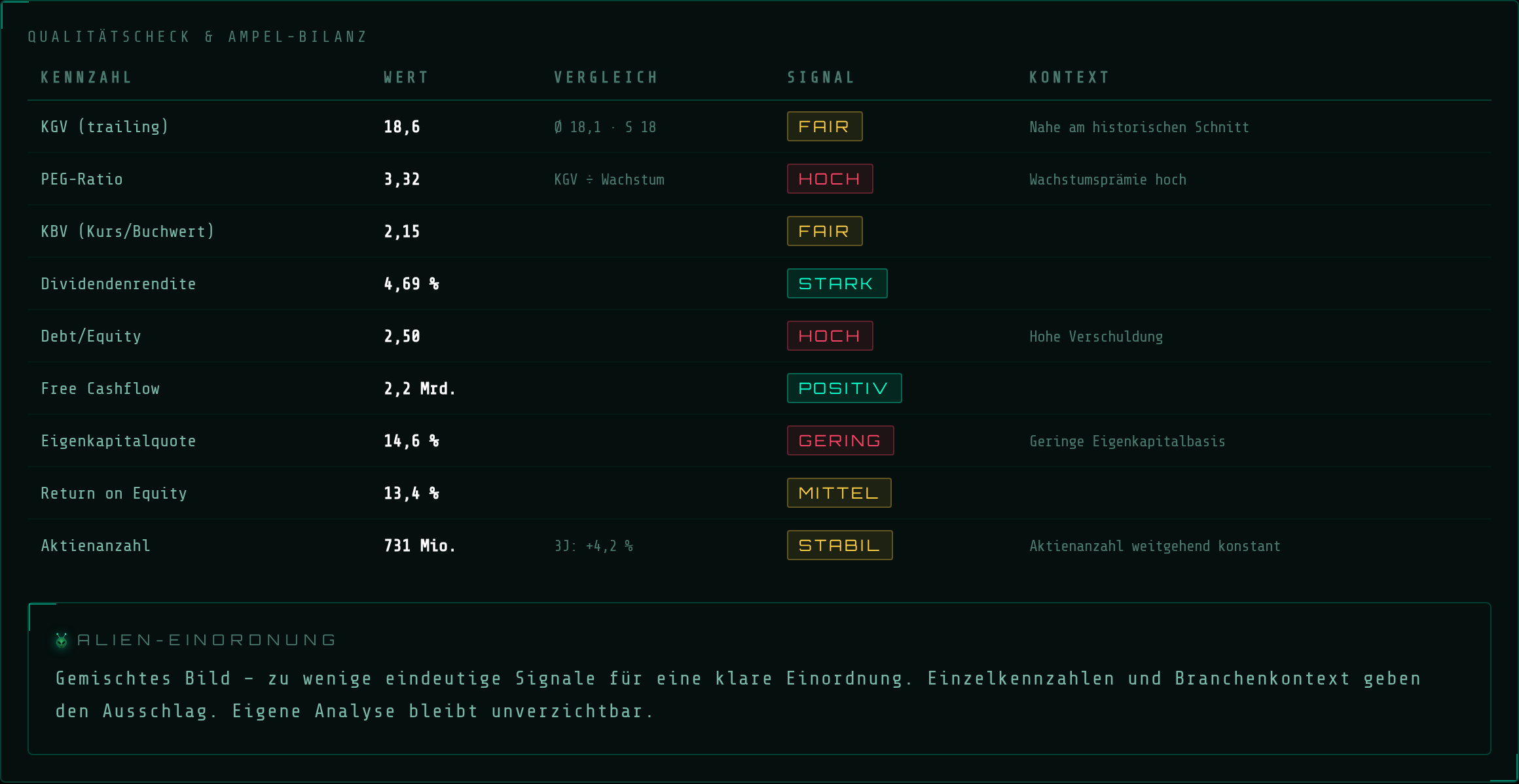
Veolia: 4.7 percent dividend and a fair P/E, but an equity ratio below 15 percent and around 19.7 billion euros in net financial debt. An infrastructure conglomerate, not a water stock. ↗ Click to enlarge
As a dividend stock with concessions Veolia is debatable, but the net margin is 2 to 3 percent and the 1.50 euro dividend uses up almost the entire reported profit. Whoever buys "water" here gets 60 percent garbage trucks and heating plants thrown in.
Geberit from Rapperswil-Jona is weighted at a good 3 percent in the water ETF, and at first glance it fits: cisterns, concealed installation systems, drinking water and wastewater pipes inside the building, everything carries water. The margins are exceptional (EBITDA margin 30.9 percent in the first half of 2026), the company has pricing power and a loyal base of installers. As a registered share on the SIX, Geberit is also the kind of ownership this channel values.
Except: demand follows the European construction cycle, not water scarcity. Revenue was 3.46 billion Swiss francs in 2021 and 3.16 billion in 2025, so in francs no growth for five years (more in local currencies; the strong franc weighs). Water saving appears at most in flushing technology. A construction quality stock with a P/E of 30 and a 2.3 percent dividend that sits in the water index because the index provider needed a category.
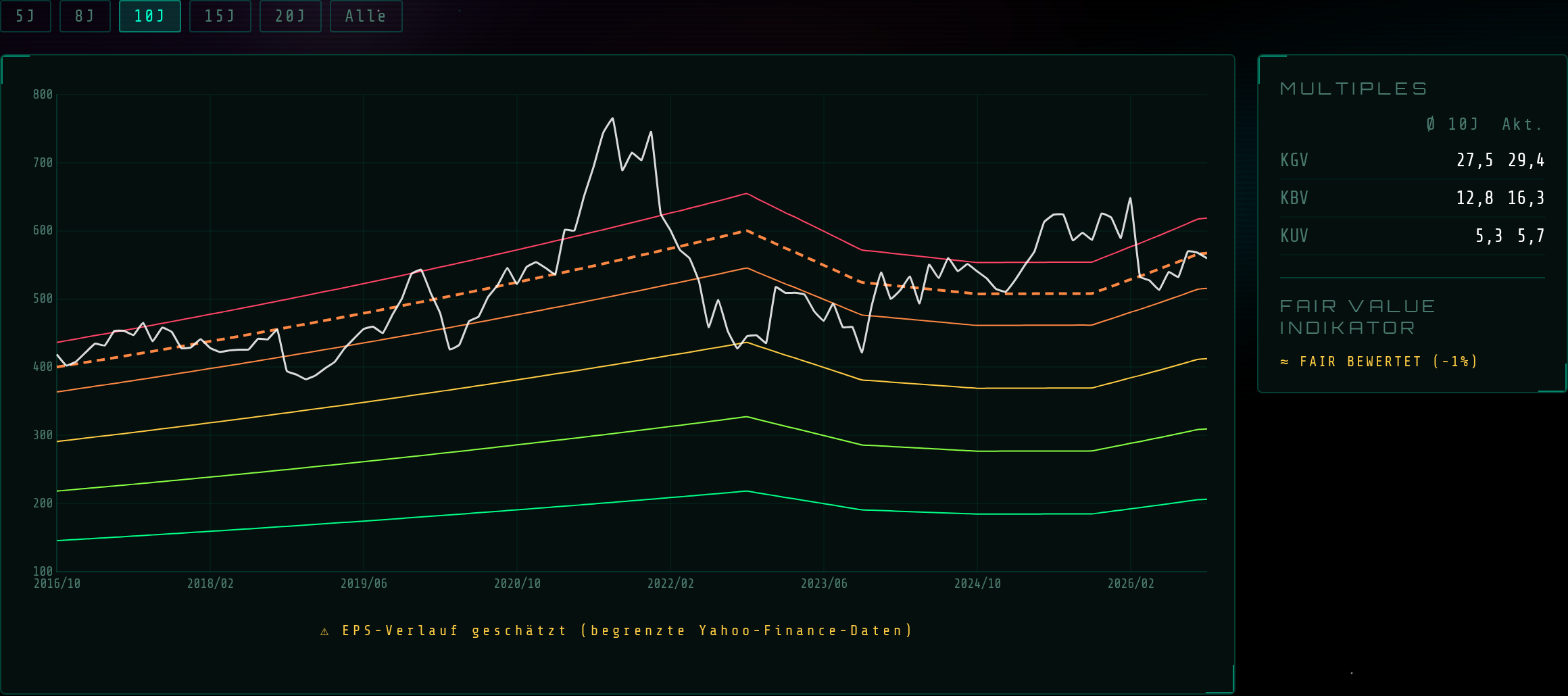
Geberit in the fair value tab: the price sits inside its historical valuation band, the P/E of 29 close to its own ten-year average. Fairly valued, for a construction cycle stock. ↗ Click to enlarge
Tool tip
All metric screenshots in this analysis come from the Alien Analyzer V2, my own stock screening tool. Fair value, multiples, dividends and quality check at a glance, for any ticker, with a DE|EN toggle. Free, no login, no subscription.
alien-investor.org/alien-analyzer – enter a ticker, analyse.
Cadiz owns around 46,000 acres of land above an aquifer in the Mojave Desert and an approved water right of 2.5 million acre-feet over 50 years. The plan: a 220-mile pipeline to the utilities of Southern California. That sounds like the perfect scarcity play. The company has been trying to get the project done since the 1990s.
The balance sheet tells the rest: an accumulated deficit of 712 million dollars, 5.3 million dollars in cash as of 30 June 2026 against around 120 million in debt at an effective interest rate of 15.4 percent, and a project capital requirement most recently estimated at 1.25 to 1.5 billion dollars. Ongoing revenue (water filters, farming) was 2.6 million dollars in the first half of 2026. The share count has risen 49 percent in three years.
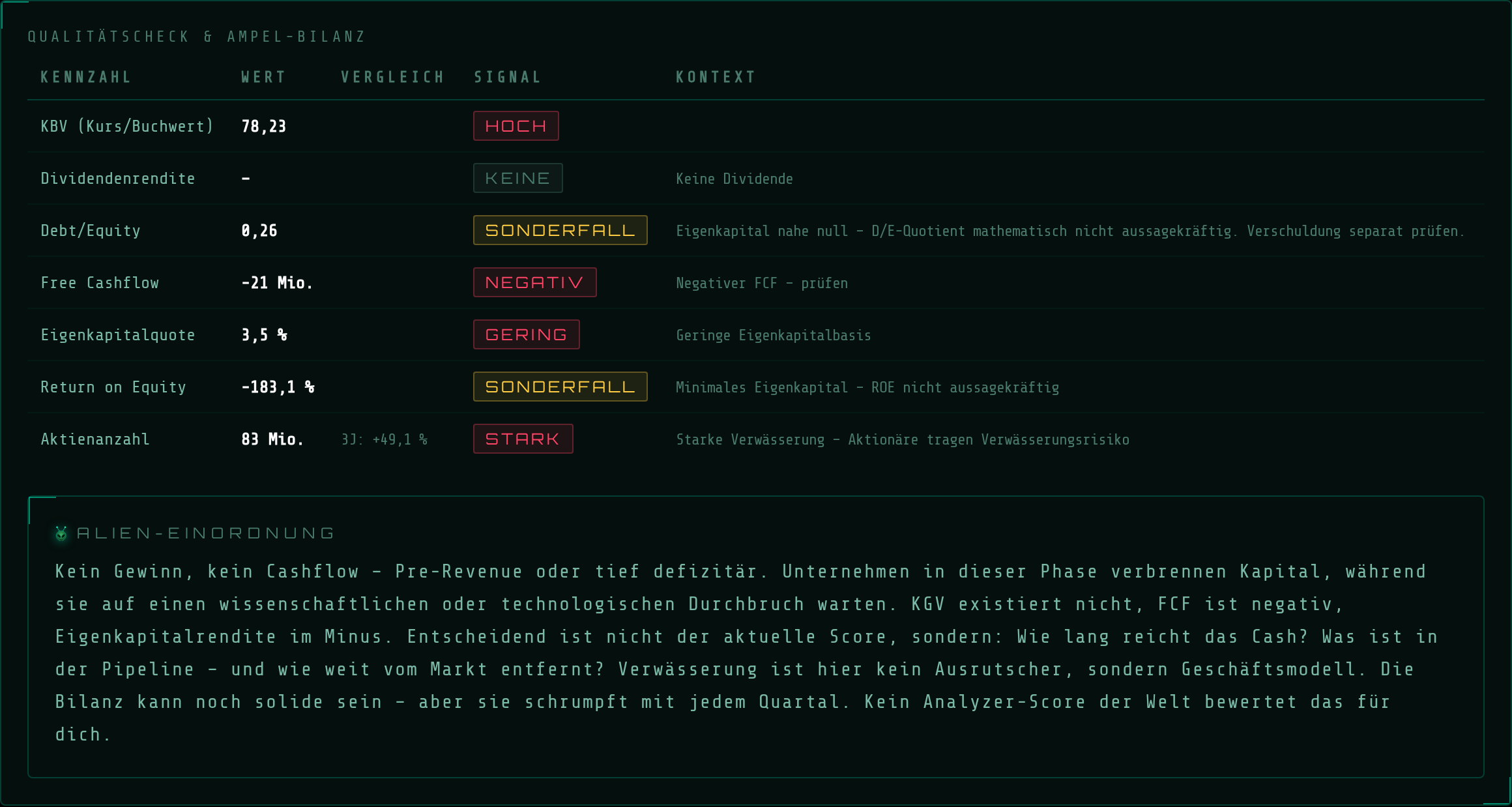
Cadiz in the Analyzer: no profit, negative cash flow, equity ratio 3.5 percent, dilution as a business model. The tool's own verdict says it: no score in the world will evaluate this for you. ↗ Click to enlarge
Cadiz is not a stock but an option on Californian water politics. Maybe the pipeline gets built. Maybe the water right will one day be worth billions. Until then the shareholder finances 15 percent interest and annual losses of 30 to 40 million dollars. The water right itself shows the problem from section 2 in its purest form: it has a value, but no market.
From the perspective of the long-term co-owner, this analysis does not yield a buy list but an order in which to think:
The commodity supercycle analysis works with the same question: scarcity or hype?
Commodity Supercycle 2026 – Selective, Structural, Substantial
Is there anything to the trend? Yes, and at a different end from the one being sold. The scarcity is measurable, but it is regional, and to a large extent it is a consequence of water having no price almost anywhere. Whoever bets on "the new oil" bets on a market that does not exist.
What does exist is forced capital spending. Lead pipes, PFAS limits, chip fabs, data centers and falling groundwater levels force utilities, industry and farmers to invest, regardless of what they think about climate change. That money lands with the equipment makers: Xylem, Franklin Electric, Badger Meter, Kurita, Energy Recovery, Lindsay. That is the substance behind the trend, and it is not green, it is stainless steel.
The hot air is elsewhere: in funds that hold 45 percent regulated utilities and sell that as water scarcity, in conglomerates wearing a water label, and in water rights without a market. And it is in the valuations: the market knows the equipment story and demands P/Es between 24 and 31 for companies that grow in the single digits organically. The thesis is right. The price mostly is not. The patient owner waits for the cycle, which turns at some point for every one of these names, and then buys substance, not headline.
"Scarcity without a price is not a market but a fight over distribution. Invest in those who supply the tools for it, not in those who fight over the water."
This analysis is not investment advice and contains no price targets. All metrics are snapshots from September 2026 taken from the Alien Analyzer V2 (data basis Yahoo Finance) and from company releases; individual Analyzer values can be distorted by data gaps and are put into context in the text. At the time of publication I hold none of the stocks mentioned. Verify everything yourself.
If you want to hold stocks and Bitcoin as independently as possible, don't rely solely on your brokerage account:
Note: Some links are affiliate links. If you use them, you support my work at no extra cost to you. Thanks!
World Resources Institute, Aqueduct Water Risk Atlas (2023); FAO AQUASTAT (2025); Jasechko et al., "Rapid groundwater decline and some cases of recovery in aquifers globally", Nature (2024); US Bureau of Reclamation, August 2025 24-Month Study; OECD, "Cost recovery for water services under the Water Framework Directive" (2024) and "Pricing Water Resources and Water and Sanitation Services" (2010); Murray-Darling Basin Authority and ABARES (water markets); US EPA, Lead and Copper Rule Improvements (2024) and PFAS National Primary Drinking Water Regulation (2024/2026); Lawrence Berkeley National Laboratory, "2024 United States Data Center Energy Usage Report"; TSMC Annual Report 2024; iShares and justETF (fund data, as of 30 Jul / 31 Aug 2026); quarterly and annual reports of the companies named (Xylem, Franklin Electric, Kurita, Energy Recovery, Lindsay, American Water Works, Veolia, Geberit, Cadiz, Badger Meter, Severn Trent, Ecolab, Valmont, Watts, Advanced Drainage Systems); Alien Analyzer V2 (metrics, data basis Yahoo Finance). As of 9 September 2026.
Thanks for your support – for free content, financial sovereignty, and the extraterrestrial resistance!