41 employees. $56.9 billion in market cap. Not a single excavator of their own. Wheaton Precious Metals does not mine a single gram of gold and is still the most valuable precious metals streaming company in the world — bigger than Franco-Nevada, bigger than any silver mining group. The record year 2025 and the largest deal in company history have re-opened the question hovering over this stock: Is this a money-printing machine — and what does the ticket cost?
"Wheaton is the merchant banker of the gold rush. While the operators dig through the mud, WPM sits at the mine exit and collects."
1) Quick Overview
| Metric | Value |
|---|---|
| Ticker | WPM (NYSE, TSX, LSE) |
| Price (August 6, 2026) | $125.30 |
| Market cap | $56.9 billion |
| P/E ratio (trailing) | 31.1× — ~27.8× after the Q2 results |
| EPS (ttm) | $4.03 — $4.51 after the Q2 results |
| Dividend yield | 0.57% |
| 2025 production | ~690,000 GEOs (guidance exceeded) |
| 2026 guidance | 860,000–940,000 GEOs |
| Sector | Precious metals streaming & royalties |
Wheaton is not a miner but a financier: the company buys future precious metals production from mine operators at contractually fixed terms — and earns the difference to the market price. The Q2 2026 results were published on August 6, 2026, one day before this analysis; wherever that shifted a metric, it is noted.
2) Business Model & Portfolio
The model is a cost-of-capital arbitrage with three payment streams — understand it once and it explains almost everything about this stock:
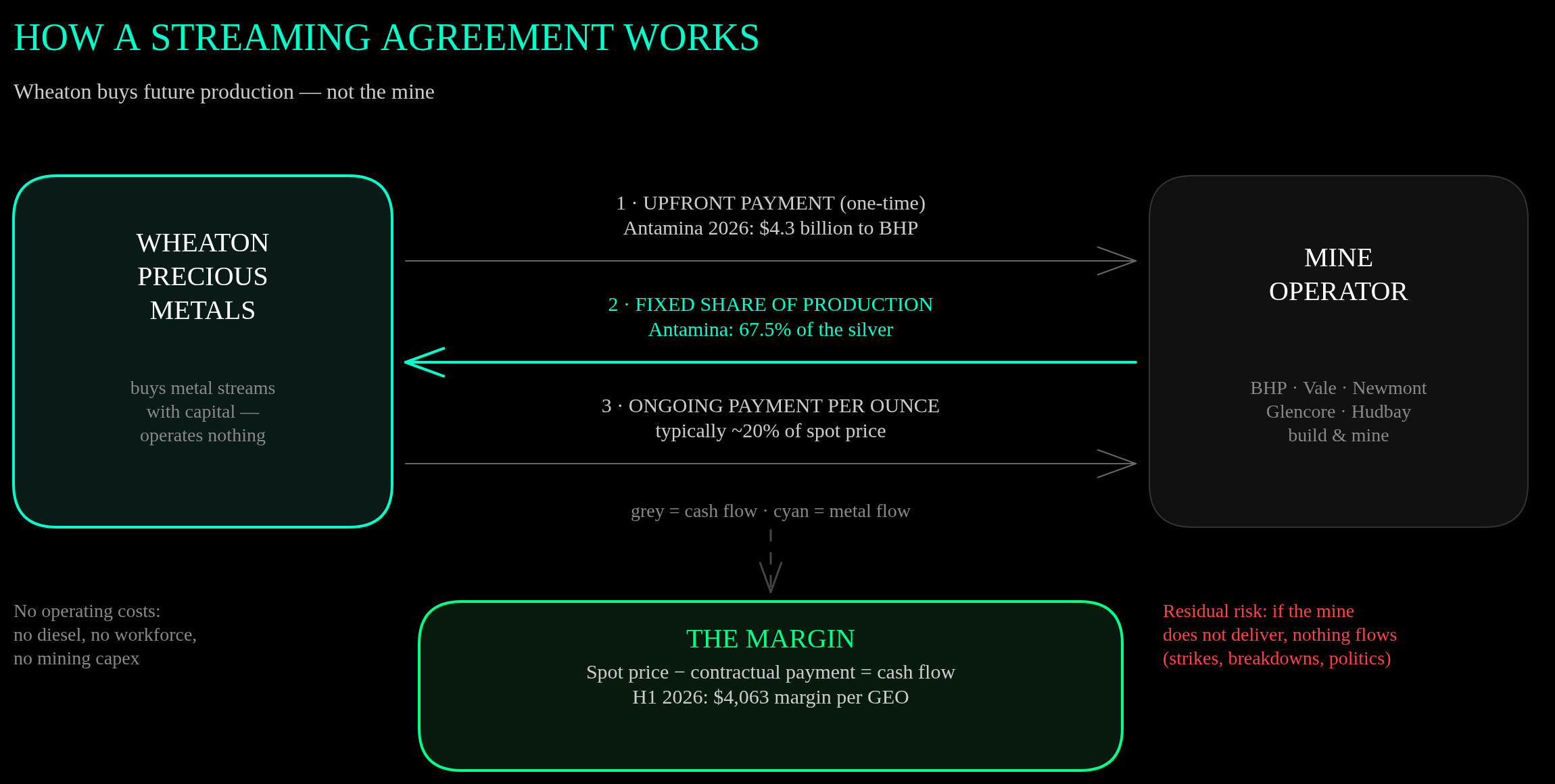
The streaming mechanics: cash flows to the mine once upfront and per ounce, metal flows to Wheaton permanently. The margin between spot price and contractual payment is the cash flow. ↗ Click to enlarge
- Upfront payment: WPM pays the operator a large one-time sum for construction, expansion, or refinancing — $4.3 billion in the 2026 Antamina deal.
- Delivery right: In return, WPM receives a fixed share of the precious metals production, often for the entire life of the mine.
- Ongoing payment: For each delivered ounce, WPM pays a contractually defined price — typically around 20% of the spot price in modern deals.
The portfolio (as of Q2 2026): 57 agreements — 22 producing mines, 20 development projects, 15 exploration-stage projects. The 2025 revenue mix: 62% gold, 36% silver, 2% palladium and cobalt. The cornerstone assets are Salobo in Brazil (Vale, 2025: 296,706 ounces of gold), Peñasquito in Mexico (Newmont, 2025: 7.77 million ounces of silver), and — since April 2026 — Antamina in Peru as the largest silver asset.
The moat: Streaming is an oligopoly. To sit at the table you need billions in capital, a decades-long deal track record, and legal-geological expertise under one roof. Operators like BHP or Vale only negotiate with counterparties that can deliver $4 billion in a single tranche — and there is only a handful of those.
3) Growth & Development
| Year | Revenue | EPS | Op. margin |
|---|---|---|---|
| 2021 | $1.20 billion | $1.67 | 62.8% |
| 2022 | $1.07 billion | $1.48 | 48.1% |
| 2023 | $1.02 billion | $1.19 | 49.7% |
| 2024 | $1.29 billion | $1.17 | 48.3% |
| 2025 ▲ Record | $2.32 billion | $3.24 | 68.3% |
What happened in 2025? Two levers engaged at once: record precious metals prices met rising delivery volumes. Revenue jumped 80% to $2.32 billion, net earnings to $1.47 billion, production to roughly 690,000 GEOs — above the company's own guidance ceiling of 670,000. And the machine keeps running: the first half of 2026 delivered $1.83 billion in revenue (after $0.97 billion a year earlier) and $1.13 billion in earnings. Each of the last three quarters set a new revenue record.
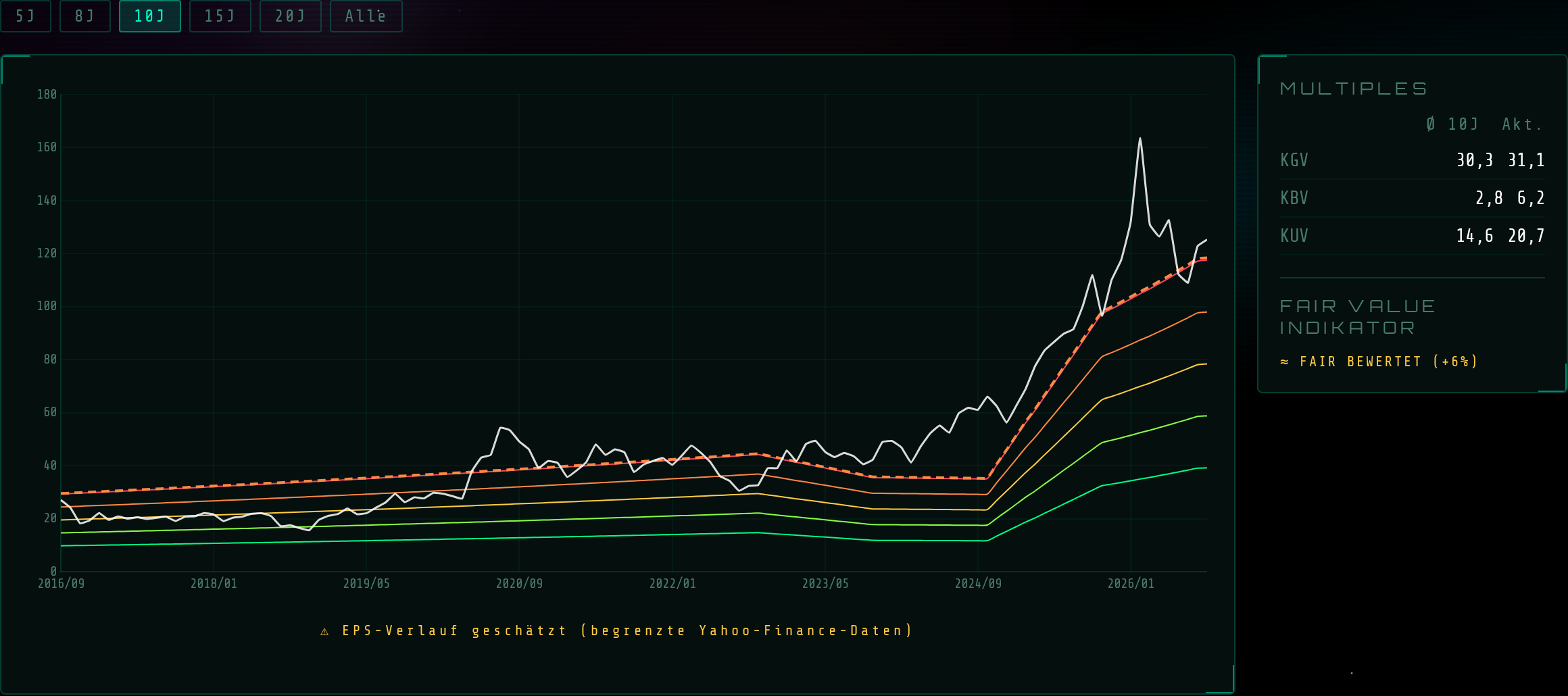
Alien Analyzer V2 — Fair Value tab: The price (white) ran ahead of the valuation bands in 2025 — and the bands are catching up because earnings grow along. Fair value indicator: fairly valued (+6%). ↗ Click to enlarge
4) Profitability & Balance Sheet
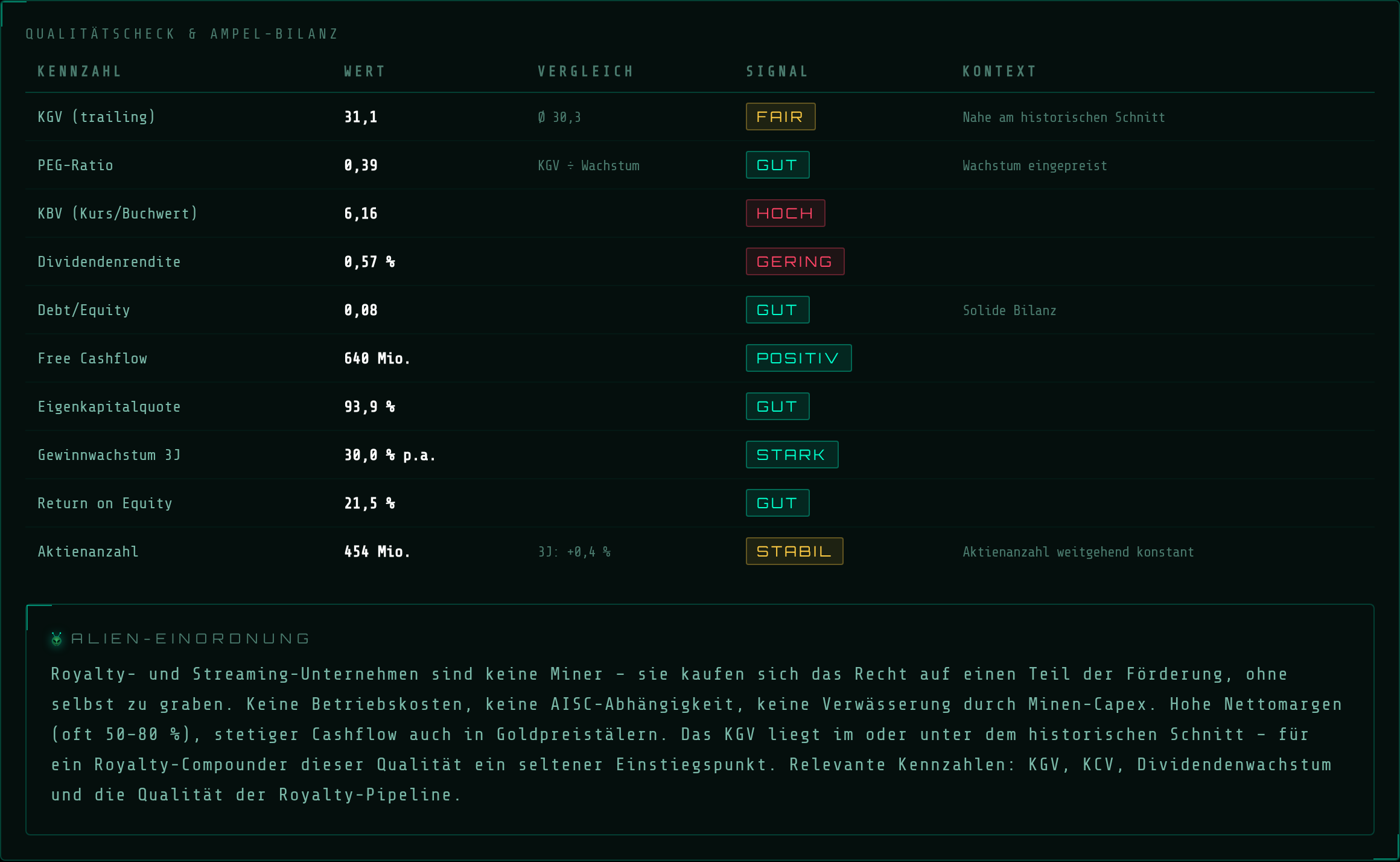
Alien Analyzer V2 — Quality check: traffic-light overview with Alien verdict (German tool screenshot). Balance sheet values still pre-Q2 — more on that below. ↗ Click to enlarge
* Important: The analyzer screenshot still shows debt/equity of 0.08 and a 93.9% equity ratio — that was the state before the Q2 results. The $4.3 billion Antamina payment was partly financed with credit: as of June 30, 2026, roughly $2.0 billion of debt sits on the balance sheet, with only ~$100 million of cash left. Debt/equity is now around 0.20 — still conservative, but the old "debt-free fortress" is history until cash flow pays the loans down.
The earnings quality underneath is the real point: the operating margin reached 68% in 2025, and the cash operating margin hit $4,063 per GEO sold in the first half of 2026 — 83% more than a year earlier. When the gold price rises, the margin rises almost one to one, because purchase prices are contractually capped. No traditional miner can offer that.
On the dividend: $0.195 per quarter for 2026, up 18% versus 2025 and the third increase in a row. The 0.57% yield is still thin — at this price level the dividend is a bonus, not a reason to buy.
5) Strategic Topics
The Antamina coup: In February 2026, WPM bought BHP's 33.75% silver stream on the Peruvian Antamina mine for $4.3 billion — the largest streaming transaction the company has ever closed. Combined with the existing Glencore stream, WPM has been receiving 67.5% of Antamina's silver since April 1, 2026, at ongoing costs of 20% of the spot price. After 100 million ounces delivered, the share drops to 22.5% for the remaining life of the mine. Overnight, Antamina became the largest silver asset in the portfolio.
Leadership change without drama: Haytham Hodaly has been CEO since March 31, 2026 — previously long-time head of the deal team. Long-serving CEO Randy Smallwood moved to Chair of the Board. Continuity instead of a strategy pivot.
The pipeline delivers: Goose (B2Gold) has been in commercial production since October 2025, Platreef (Ivanhoe) and Fenix (Rio2) are slated to follow in the fourth quarter of 2026, and Blackwater (Artemis) is building Phase 1A for a production contribution from 2027. On top of that sits the stated goal: roughly 1.2 million GEOs of annual production by 2030 — about 50% above the 2026 level — and holding that level through 2035.
Taxes have become real: The global minimum tax (15%) hits the model noticeably. In June 2026, WPM paid $109 million for tax year 2024, and around C$346 million is due in March 2027 for 2025. The old tax edge of the streaming structure is shrinking.
Watch the planning assumptions: For its 2026 guidance, management assumes $4,800/oz gold and $80/oz silver — current market prices, not conservative buffers. Whoever reads the growth targets should know: they depend on the metal price scenario.
6) Valuation in Context
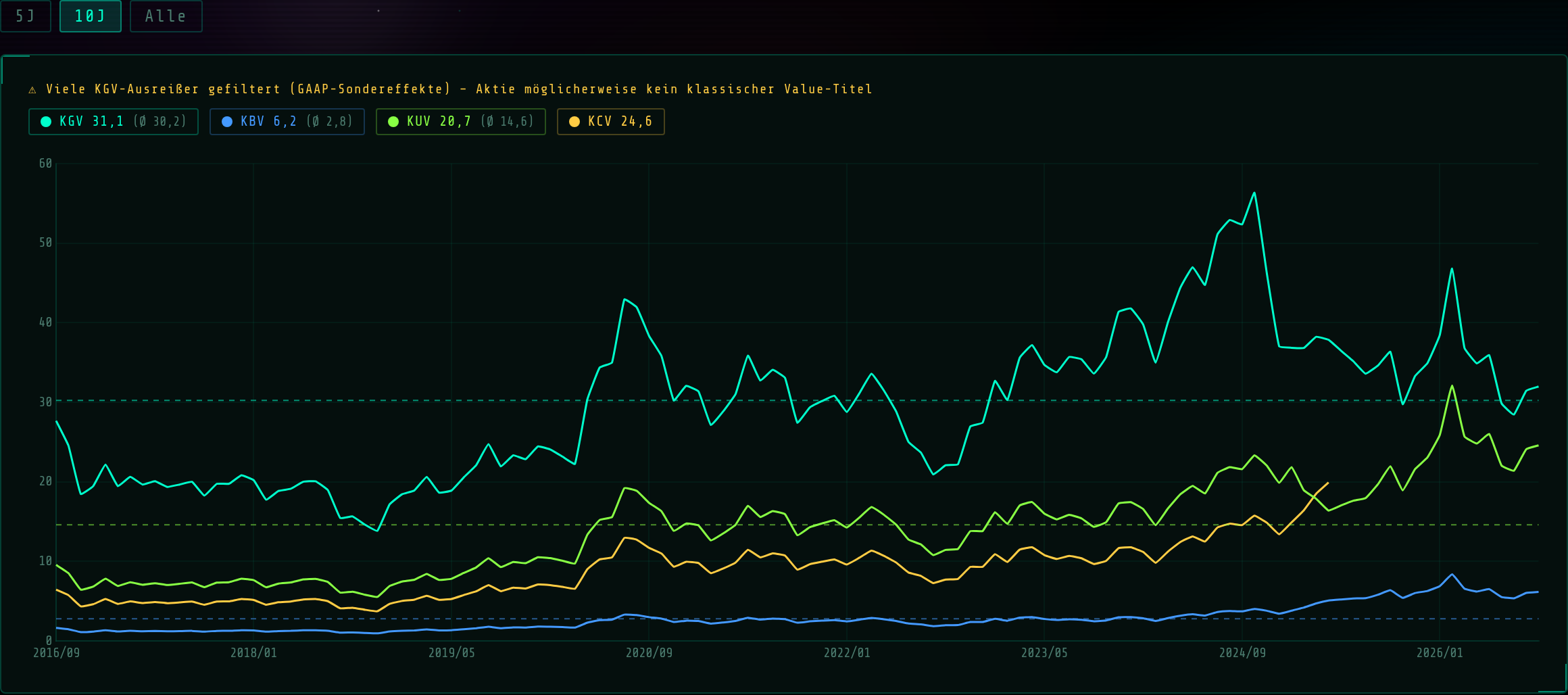
Alien Analyzer V2 — Multiples tab: P/E 31.1 (avg 30.2), P/B 6.2 (avg 2.8), P/S 20.7 (avg 14.6), P/CF 24.6 over 10 years. The analyzer also warns: many P/E outliers filtered — not a classic value stock. ↗ Click to enlarge
The remarkable thing about this valuation: the share price has more than doubled since late 2024 — and the P/E still sits right at its historical average (31.1 vs. an average of 30.2; roughly 27.8 with the fresh Q2 numbers). Earnings simply grew along. The PEG ratio of 0.39 says the same from the other side: measured against earnings growth, the P/E is moderate.
The asset-based metrics tell the counter-story: P/B of 6.2 (historically 2.8) and P/S of 20.7 (historically 14.6) sit well above their own averages. You are not paying for book value here but for a cash-flow machine — and pricing in that metal prices and pipeline deliver. The analyzer's fair value indicator lands at "fairly valued (+6%)": no bargain, no excess. That is a model calculation based on historical multiples, not a guarantee.
Tool tip
The metrics in this analysis come from the Alien Analyzer V2 — my own stock screening tool. Fair value, multiples, dividends, and quality check at a glance. Free, no login, no subscription.
alien-investor.org/alien-analyzer — enter a ticker, analyze.
7) Competitive Landscape & Moat
| Company | Focus | Market cap | Distinctive feature |
|---|---|---|---|
| Wheaton (WPM) | Streaming, gold + silver | $56.9B | Largest pure precious metals streaming house |
| Franco-Nevada (FNV) | Royalties + streams | ~$44.7B | More broadly diversified, including energy royalties |
| Royal Gold (RGLD) | Royalties + streams | ~$18.5B | Merged with Sandstorm Gold in Oct. 2025 |
| Triple Flag (TFPM) | Streaming, mid-tier | ~$6.6B | Smallest of the four, hungry for growth |
WPM has overtaken Franco-Nevada in market value and is currently the clear number one of the sector. The difference in profile: Franco-Nevada spreads wider (including oil and gas royalties), Wheaton is the purer precious metals bet with the larger individual streams. Royal Gold bought scale via the Sandstorm takeover. The sector's moat is the same for everyone — capital, reputation, contract expertise — but whoever can shoulder $4.3 billion in a single transaction, like WPM, plays in a league of their own.
8) Partner Perspective
Wheaton's "customers" are the mine operators themselves — and their operational reality is the real concentration risk. 2026 delivered several case studies at once: a gearbox failure at the Blackwater mill in March (about a week of downtime), the Los Filos mine that only restarted in June after a long dispute, via a 20-year agreement with the local communities, and Stillwater, which has been running on care and maintenance since September 2024 because of weak palladium prices. WPM caused none of these problems — all of them hit its cash flow.
The defense is diversification and partner quality: 57 agreements, including groups like BHP, Vale, Newmont, and Glencore. Public B2B ratings in the classic sense do not exist for this business. [NOT AVAILABLE]
9) Employee Perspective
41 employees manage 57 agreements and $56.9 billion in market value — almost $1.4 billion of market cap per head. That may be the most extreme capital efficiency in the entire commodities sector. The flip side: at its core the company is a deal team of geologists, financial engineers, and lawyers. If the wrong handful of people leaves, the machine suffers. Public employer ratings are not meaningful at this team size. [NOT AVAILABLE]
10) Opportunities & Risks
11) Alien Verdict
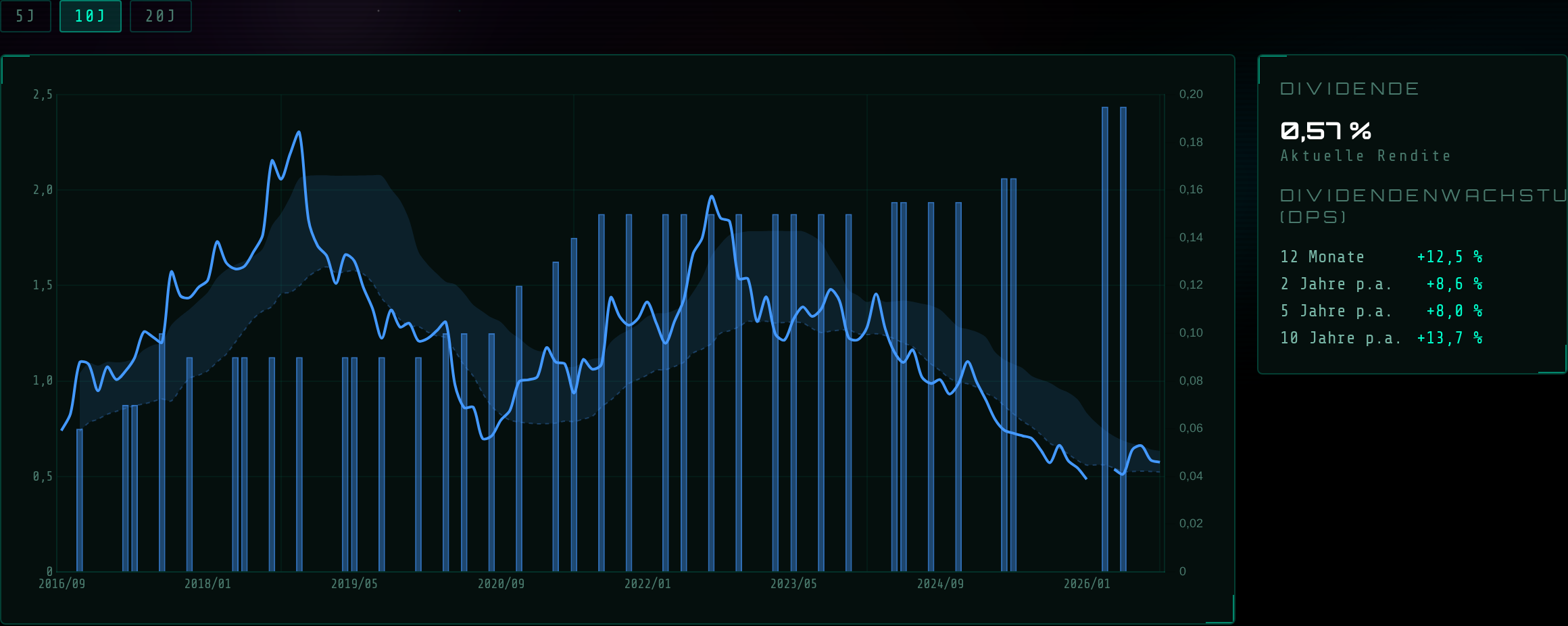
Alien Analyzer V2 — Dividend tab: 0.57% yield, but +13.7% dividend growth p.a. over 10 years. The yield looks small because the share price ran away. ↗ Click to enlarge
Wheaton is the financial distillation of the precious metals sector: full price leverage, no operating costs, a 68% operating margin, and a set of contracts that structurally locks out competition. The record year 2025 and the Antamina deal showed what this machine can do when metal prices and the deal pipeline deliver at the same time.
But you have to read both sides of the scorecard. The P/E looks surprisingly tame at 31 (or ~28 after Q2) for this quality — because earnings exploded. P/B of 6.2 and P/S of 20.7, on the other hand, say clearly: there is no asset discount here like with a cyclical at its bottom. Whoever buys today buys an excellent machine at full price and bets that gold prices and pipeline hold the level. If either disappoints, a premium stock corrects faster than a cheap one.
The new reality belongs in the picture as well: $2 billion of debt after Antamina and a minimum tax costing nine-figure sums. Both are manageable — but the days when WPM passed as a debt-free tax haven are over.
"You are buying the toll booth of the gold rush — not the gold mine. It is just that the toll booth now has a gold price of its own."